Friday, July 20, 2007

post-modern jazz guitar pt. 0b: 10 seconds of post-modernity


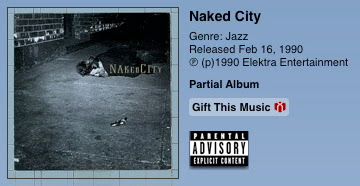
…But before I go I’ll let you in on the exact track I was talking about: ‘Snagglepuss’, track 7 of Naked City’s self-titled debut. What was my introduction to post-modern jazz guitar occurs at around 1' 40" of the track and lasts barely 10 seconds.Naked City at iTunes with explicit content warningIncidentally, the partial album (22 out of 26 tracks) is available on iTunes (with the complete album promised). Comically, this comes with an “explicit content warning” label which, I presume, is for the album artwork rather than for Yamatsuka Eye’s vocalese (but, hey, what do I know; I have no window into the workings of the RIAA). At ¢99, and clocking in at 2' 20", ‘Snagglepuss’ works out at just over ¢1.4 a second. That’s not much byte-for-your-buck, but much better than paying ¢9 a second for one of the 11 second tracks.

we all scream for, er, paperwork

“What’s not a priority… is those matters which are of less of a… not that they’re not important, but… if you’re going to have a front burner—which is where you want your priorities—it’s like cooking: there needs to be something sitting on the back one.”
from John Sayles dir. (2004), Silver City.
Call it applying for grants, fishing for funding, or begging to perform, paperwork by any other name would still be odious. Most people have death and taxes, musicians get additional administration (and don’t talk to me about college loans).
Anyway… the paperwork I talked about previously is in need of my attention so blogging will unfortunately be taking a back seat again.

tig will be back (with some luck) shortly.

But before I go…

Wednesday, July 18, 2007

post-modern jazz guitar pt. 0a: comments and responses

A little while ago, PB commented that

…one could argue that all ‘jazz’ is post-modern, using found materials, drawing from the street as much as the academy, appropriating influence wildly… perhaps even improvisation itself is a thoroughly post-modern conception.
But, if anything can be thrown under that label, is it at all useful?
Mwanji Ezana asks if Jason Moran a post-modernist? I’m tempted to paraphrase Mwanji’s question as, is anyone a post-modernist? Or, in a form that might be easier to answer, is labeling anyone a ‘post-modernist’ useful / illuminating / fun / playful? My answer is a tentative no, it isn’t. On the other hand, if we’re interested in the condition rather than a post-modern aesthetic (whatever that might be), maybe we would usefully look for the post-modern in our listening / witnessing.
So, another question: does, or do the performances of, Agossi, Frisell or Moran elicit a post-modern reception?

Pat Donaher at visionsong expresses reservations and skepticism on the grounds that the post-modern tends towards valuelessness:
…Post-modernism… rests on the idea that no art has true intrinsic value…. And if you're ironic… you don't have to be honest….
…It's the guest at the party that oozes coolness, impresses the herd, says witty but empty things, and ultimately contributes nothing to the event. If that is where art is, or is headed, it's something I want no part of, and want to show up as a clothesless emporer.
And to paraphrase visionsong’s question (which relates to PB’s observation, and is similar to Mwanji’s question), is Brahms’ Variations on a Theme by Haydn post-modern? Well, maybe not, but, with a little work, we could hear it as such.
I am sympathetic to Pat’s desire for value in art, but I don’t agree that a post-modern reading necessarily lends itself to a valuelessness, its just you have to work much harder for it—you certainly cannot take it for granted, nor can you ever assume that its shared by others. I agree that post-modernism (like its cousin post-structuralism) offers a potential for a lazy libertarian relativism, but with a little care, I think it can also be culturally, politically liberating.

More to come…

Monday, July 16, 2007

post-modern jazz guitar pt. 0: electric authenticity

Continued as promised

When asked, in an article in The Guardian, if she gets frustrated by other singers’ approach to standards, Mina Agossi answers:

…Some people sing standards in the way that the greats did, with such conviction, love and authenticity that, really, it touches me. But if you ask me whether I learn something from that, or if it is something that opens a door, I would say no. It's beautiful, it's nice, but it doesn't touch me.
What happens when Agossi evokes, say, Billie Holiday (or any number of others) in her performance? What happens when I hear something of Holiday in Agossi—a singer/vocalist with much greater range than Holiday ever had? Not directly quoting Holiday, not mimicking Holiday (well, not exactly), and certainly not pretending to be Holiday. Nevertheless, what’s happening, and why is it electric?

visionsong impossibly (and fantastically) managed to get ‘postmodern’ and ‘authenticity’ to sit next to each other:
If there is such a thing as postmodern authenticity, then he's [Bill Frisell’s] it. He was embracing an eclectic mish-mash of Hendrix, folk Americana, thrash and bleep and blurp long before most of them were in vogue, and the times seem to have caught up with him, in a good way.
I recall the first time I became aware of ‘post-modern jazz guitar’ (or maybe that should be ‘‘post-modern’ ‘‘jazz’ guitar’’ or something) even though I wouldn’t have been able to call it as such at the time.
Bill Frisell’s sound I knew from some sporadic, and sometimes eccentric, appearances as sideman, most notably (to my ears at the time), as the quirky, independent-minded ‘other’ guitarist in Bass Desires (hey, anyone remember ‘Twister’?), but it’s his appearance on the self-titled Naked City debut recording (1989, Nonesuch) that marks my introduction to post-modern jazz guitar.

On some mundane, obvious level, Naked City was scatter-brained. Certainly critics at the time of its release, possibly because of a concern for material rather than practice, had difficulty hearing anything other than post-modern collage. On the other hand, in retrospect, it’s perhaps surprising that so little of the band had an overtly post-modern agenda: Fred Frith would return to that hybrid rock experimentalism; Joey Baron had no difficulty retaining his all-purpose bounce; Wayne Horvitz continued to walk the tight-rope act of downtown traditionalist; maybe even John Zorn’s taste for bricolage and sampling had more to do with the collision of Experimentalisms, African-American ‘noise’, and hardcore.

And then there’s Frisell.

Frisell’s interest in Americana, and, latterly, in cross-cultural (mis)understandings, displayed a concern for history that went beyond the temporal agnosticism of post-modernism.

Or did it?

Frisell’s deployment of those ’bop licks acknowledges history—of precedence—but it is not about authenticity, nor does it purport to be authentic. It ain’t authentic in either the sense colloquially used in the domain of historically informed performance (of which jazz neo-classicism might be a special branch), nor in the sense of an embodied authenticity as Simon Frith-ites might discuss in the context of popular music. This enrollment of jazz guitar history and practice is a strage and fascinating, perfectly crafted piece of… of what?
I’m not sure what I’m hearing when I spin that track (I’ll let you in on the exact track in the next part of this thread). Am I hearing a condensation of history (a collapsing of time), or a meaningless token (albeit free from the pretentions that dogs neo-classicism)? Is it a form of due-paying, or is it mocking the jazz traditions’ emphasis on cultural lineage? Or something else? or something in between? or a rapid-fire oscillation between states? I don’t know what I’m hearing, but the effects are dramatic (in that microcosmic moment) and electric.

To be continued…

an (unanswered) question

Does Frisell cultivate that shy, gawky, slightly goofy mid-western persona?
MLM and I used to joke that Frisell would meticulously practice his awkward delivery in preparation for introducing his band/pieces. Are questions of authenticity relevant to Frisell’s persona? Is it an act? Is persona (or identity) performance?

…and two questions from last time

What is, or what is constructed by the label, post-modern jazz?
Is, or do you find, post-modern jazz to be a positive development?

Monday, July 09, 2007

thoughts from a concert

preconcert

Does TA know everyone in this town?

Audience demographics: about 3-to-1 male-to-female, fairly broad age range (possibly not many below their twenties, however), predominantly white (although I’ve seen worse).

support act

That’s a strange choice for a support band.
Do large (very much formal) venues have separate committees for the A and B acts? Do these committees program their acts largely independently, and then try and match the acts as best as possible?
I enjoyed performances by this band in the past, but I’ve brought the wrong set of ears tonight.

MLM’s comment: “I’d hate to be in their shoes.”

Oh god. I hope those balloons weren’t meant as a homage.

main performance

I am so glad I could witness this. [Warning: upcoming tasteless comment] I am in the presence of giants.
Interesting tactics: elements that ‘sound’ serendipitous are actually prepared, each musician picking-up on, and capitalizing on, cues from the other, (retroactively) making it sound like their individual gestures are internally consistent while ‘magically’ matching each other’s.
I know a lot of their moves. Not enough for it to be useful if I were (heaven forbid) on stage with them, and certainly not in the way they can (ir)rationally respond and anticipate each other, but, nonetheless, I know a lot of their moves.
I wish my students were here.

Wow.
Wow! That was cool!

They’re using a tape…?
Is that a tape part…?
…no…?
…that’s the clarinet?!?
Oh. My. God. If you can do that with a clarinet, why would anyone want to (or be compelled to) use a laptop?
I am in the presence of giants. [Apologies for that second tasteless outburst.]
I am lost in the moment.
Questions: does being in the position of having played with the two nominal ‘leaders’ (with formidable egos) put you in the position of negotiator / mediator? Does that position endow you with privileges / powers / controls / responsibilities—look one way, one possible ensemble; look the other, another?
Power flows though the negotiator. MLM: “But he’s hardly playing anything.”
This is dense: compelling, complex, and flying dangerously and dramatically close to the moosh.
I see logic in the choice of reeds. During this dense moment, a sopranino will hover far, far above the rest of the ensemble’s sound space, out of everyone’s way.
How the hell do you break out of this noise? What could possibly put the breaks on this system without creating an anti-climax?
That’s how.
A ‘false’ ending, and / but a little tactical flourish to put the breaks down. (And—feels almost magical—the audience conspires on this ending.)

Man, it doesn’t get much better than this.

final comments

MLM: “So many people walked out.”

I recall AF (a fine sound engineer for this and related genera of musics) critiquing engineers who mix with the expectation of a foreground (solo) and a background (accompaniment). Same problem dogged some of the earlier moments of this performance. Flatten the levels and let the audience do the mixing.
Friday, July 06, 2007

post-modern jazz guitar (preamble)

I’m out of town (always a little strange to be traveling without being weighed down by a guitar and amp) so I’ll be offblog for a few days. When I return, I plan to write on the subject of ‘post-modern jazz (guitar)’, so…

a couple of questions for y’all

What is, or what is constructed by the label, post-modern jazz?
It’s not at all a straightforward thing to use the ‘post-modern’ moniker in place of other labels (‘classicism’, ‘expressionism’, ‘orientalism’, etc.). The (informal? tenuous? hostile?) relationship between (cultural) modernism and (social) modernity finds no correlating expression between post-modernism and post-modernity. How can the post-modern stand for an aesthetic or sensibility? it is, after all, a condition, not a era or a milieu.
Of course, none of that stops us from trying.

Is, or do you find, post-modern jazz to be a positive development?
I’m curious about your reaction to post-modern jazz (whatever that is, and if such a thing exists): positive, negative, indifferent?

Wednesday, July 04, 2007

i declare this myspace


What better way to mark the 4th of July but by announcing improvising guitar’s pledge to be part of Rupert Murdoch’s Empire (albeit a small, confused peninsula somewhat removed from the centers of colonial influence)—the Empire responsible for possibly the silliest expression of patriotism. (I almost can’t believe that I’m doing this; am I not getting a little old for this stuff? social networking? pah!)
Nevertheless, it is with almost patriotic pride (of the “patriotism swells in the heart of the American Bear” variety) that improvising guitar announces a MySpace presence:

www.myspace.com/improvisingguitar

Sunday, July 01, 2007

my little downbeat readers poll

Hey kids! It’s that time of year to try and think of obscure stuff to clog up the pipes at DownBeat Central. I list my weirder and more odd-ball [ed. can things be more/less odd-ball?] choices. Now ‘weird’ and ‘odd-ball’ in this situation means that these will never get past the first stage (not that that’s exactly difficult in regards to DownBeat Central).

1. Hall of Fame: Pauline Oliveros
2. Jazz Artist: Mina Agossi
3. Jazz Album: Anthony Braxton & Fred Frith, Duo (Victoriaville) 2005 [pdf] (Victo)

5. Jazz Group: Green Room [pdf]

17. Electric Keyboard/Synthesizer: Bob Ostertag

21. Percussion: Thomas Strønen

23. Miscellaneous Instrument: Laetitia Sonami (everyday and not-so-everyday technologies)

25. Female Vocalist: Petra Haden

I’m sure you kids can do much better that I did, but remember, you have to follow the letter of the law (to hell with the spirit, eh).

Saturday, June 30, 2007

index 06–30–2007

A partial and selective index of articles, posts and other detritus. Only covers posts up to and including June 30th 2007.

tutorials
harmonics
playing in position
training (the) quartet

articles
the closed laptop
practicing
solo
technological dramas
what’s in a name?

informal threads
canons and canonizing
cyborgs and cyborgism
society in miniature
tactics and structurings
why improvise?

most commented

labels/keywords


tutorials

harmonics
harmonics pt. 0, the physics of
harmonics pt. 1: where are they?
harmonics pt. 2, the picking hand and
harmonics pt. 3: cataloging and improvisation
harmonics pt. 4…

playing in position
playing in position pt. 0, reasons for
playing in position pt. 1: don’t get lost
playing in position pt. 2: physiological compromises
playing in position pt. 3: learning the geography
playing in position pt. 4: what about finger independence?
playing in position pt. 5: one string melodies (again)
playing in position pt. 6: more physiological compromises
playing in position pt. 7a: learning the geography (again)
playing in position pt. 7b: learning the geography (again)
playing in position pt. 8a: one string melodies (yet again)
playing in position pt. 8b: one string melodies (yet again)
playing in position pt. 9: fingerboard geometry
playing in position pt. 10a: spanning a third
harmonics pt. 10b… (forthcoming)

training (the) quartet
training (the) quartet pt. 0: why four?
training (the) quartet pt. 1: protocol of mirroring
training (the) quartet pt. 1.1: protocol of affinity
training (the) quartet pt. 2: network topologies
training (the) quartet pt. 3… (forthcoming)

articles

the closed laptop
the closed laptop pt. 0: a cautionary tale of performance practice
the closed laptop pt. 1: i/o? what i/o?
the closed laptop pt. 2a: deliver us from our bodies
the closed laptop pt. 2b… (forthcoming)

practicing
practicing: the journey (and the destination)
practicing: systems, routines and shake-ups

solo
solo: alone together
solo: writing about music is like…
solo: niche in the ecology
solo: my humble lexicon
solo: primary territories

technological dramas
technological dramas pt. 0: piano mobility
technological dramas pt. 1: performing ‘normal’
technological dramas pt. 2… (forthcoming)

what’s in a name?
what’s in a name: free improvisation
what’s in a name: non-idiomatic vs. pan-idiomatic
what’s in a name: non-idiomatic improvisation
what’s in a name: the j-word

informal threads

canons and canonizing
an application of the principles of canon formation
an application of the principles of canon formation II
race: how many of us are just visiting?
the best of jazz of the 2010s
ten reasons lists might be trouble
See also ‘what’s in a name?’.

cyborgs and cyborgism
the (finite?) instrument
the instrument: of cyborgs and performance
keith rowe: an appreciation
See also ‘solo’ and ‘technological dramas’.

society in miniature
group improvisation: a question of leader(ship)
structur(e|ing): towards a music(ology) of verbs
society-in-miniature: diplomacy
‘society-in-miniature’? but where does the stage end?
mob behavior and the hegemonic impulse
See also ‘why improvise?’, ‘cyborgs and cyborgism’, ‘tactics and structurings’ and ‘training (the) quartet’.

tactics and structurings
limits and boundaries, purpose of
limits and boundaries: wikiality
structur(e|ing): towards a music(ology) of verbs
from the road: novel social structur(e|ing)s
endings: or engineering serendipity
learn a few moves, and make up the rest
engineering ritual: a curious case of the body in concert
structure|ings: engineering serendipity
contrasts and juxtapositions
mob behavior and the hegemonic impulse
the art of persuasion
‘responsible’ listening
See also ‘cyborgs and cyborgism’, ‘solo’ and ‘training (the) quartet’.

why improvise?
why improvise?
why improvise? redux
why improvise? the leap off the edge

most commented

society-in-miniature: diplomacy
structure|ings: engineering serendipity
what’s in a name: non-idiomatic improvisation
daily recommended traditional intake
an application of the principles of canon formation II
some observations i brought home

labels/keywords

audience, body, composition, group, guitar, identity, instrument, interaction, listening, pedagogy, score, social, solo, strategy, technique, terminology, tradition, tutorial

Friday, June 29, 2007

sidebar links, overhaul of

Here’s the long overdue overhaul of the sidebar links.
Blogroll: Since I don’t like to remove items from it, I’m maybe a little overcautious about adding stuff to the blogroll. Talking of which, it’s farewell to Bagatellen since I discovered that, while it dutifully arrives in my feed reader, I only ever read an article once in a blue moon. For the moment, the sidebar blog links starts at AvantUrb and ends with Settled In Shipping, but there’s some other music related stuff in my sand box, so more will be added….
I’ve deleted the links to the AACM, the LMC, European Free Improvisation, etc. I figure that most of the readers of this blog knows about them anyway, and there are much better hubs for these kinds of links anyway. (I’ve, however, kept the links to various guitarists for the time being.)
Anyway, enjoy, but remember, links are not to be taken internally.

tig