Showing posts with label pedagogy. Show all posts

Tuesday, October 14, 2014

Kind of Weird

Before people get too worked up over this, they need to realize that our album is a copy, not a clone—an object designed to reaffirm what people already love about ‘Kind of Blue’ and to highlight what we could and couldn’t pull off…. That’s where the art is—getting people to think about the original by listening harder to the differences. [more…]
Been following the MOPDTK/Blue threads here and there on fb with some interest. Some random questions:
  1. When does musical criticism cross into personal attacks? Is the personal and the musical ever separable, in particular, in the context of improvisative practices?
  2. At what point does musical proficiency sanction an entry into the hallowed domain of reinvention? (or is that question just wrong? what is at stake?)
  3. If the piece is a conceptual prank (of sorts), then is not the kerfuffle a demonstration of its success?
  4. If the piece is a conceptual prank, who or what was the target?
  5. When are we comfortable discussing the intersections of class, economics (and race) and music? (and if we can’t do this in the context of a kind of appropriation, when can we do it?)
I’ll admit straight off the bat that I’ve never been particularly drawn to MOPDTK’s work (no fault of theirs, just never got around to it), but this did at least get me to listen. fwiw, some thoughts (my ¢2):
  1. There’s a self-consistent argument from those critical of this project that goes like this: by all means do your own music—be creative!—but if you were to copy an existing work, your chops should be up to the task. I’m not 100% convinced by this argument, though it’s hard not to agree that there are people with more aptitude for meticulous recreations. I think notions of ‘authenticity’ and ‘respect’ (to/for yourself, the tradition, cultural ancestors, etc.) play in both pro/con arguments, but that are largely left unexamined.
  2. Given the continuing struggle with notions of history, continuity and tradition that is so much a part of this music’s DNA, it occurs to me that it would be naïve of anyone to think that the album would not generate, at the very least, heated discussions.
  3. It seems to me that that the target could not have realistically been the Lincoln Center neoclassicists and their audience since, given the nature of the band and the label, this piece of cultural noise would just not be audible there. So, it seems to be reasonable that the target of the prank was those of us already on the left-field (those of us already defending or critiquing this work), but that raises a whole bunch of additional questions about purpose, and questions about how to assess the success of the prank.
Final thought: I find it near impossible to hear Kind of Blue with something other than naïve teenage ears (which is how I first encountered that record). So I feel unqualified to do a critical, microscopic assessment of MOPDTK’s work-as-copy. From hearing a short excerpt from MOPDTK’s album, however, all I can add was that I was surprised how well Jon Irabagon could reembody Adderley, and fascinated how Peter Evans apparently could not mimic Davis to the same degree.

Friday, December 28, 2012

unmasking tig

Although the most recent post is dated October 2012, improvising guitar hasn’t been active in any meaningful sense since January 2008. I started this blog in order to explore ideas of improvisation and technique, and as an outlet to vent issues emerging from my teaching [more…]. It was primarily for the latter reason that I adopted a pseudonym—the improvising guitarist, or tig. This was all in the relatively early days of weblogs, and, subsequently having written here and there under my non-pseudonymous name, I now feel more confident about expressing issues online without getting myself (or anyone else) into trouble.

As I said, I am “tempted to ‘come out of the closet’ on this blog,” so…


I still blog occasionally on (relatively) specialist matters, but, if you’re looking for my “unplanned collection of thoughts about the technical, social, pedagogical and practical dimensions of loosely idiomatic, sometime experimental, mostly open, always traditional improvisation”, your best bet, currently, is at a certain micro bogging platform.

Thanks for reading, everyone. Hope I can (again) make your acquaintance.

tig
Brooklyn, December 2012

P.S. a shout out to Kris Tiner, afaik, the only person who guessed the identity of tig.

Wednesday, October 24, 2012

practice based research: policing the borders of knowledge

Practice based research is not only a methodology, but is also tied to a metric, and, for you to be successful according to a metric, you need to play the game.
When I first encountered the term ‘practice based research,’ it promised to forge an academe that was more inclusive, border crossing. With creeping corporatism, however, practice based research instead became a way to solidify borders.
We all play the game. A (successful) practitioner outside academia knows to discriminate in their networking; to remember to, say, ask the Important Person at a concert about their family, to compliment the right people at a gallery, to have the right guest performer on their record, etc. And academia—with its bureaucratic pressures, need for peer esteem, to demonstrate ‘value’—is perhaps no different. As universities become knowledge/degree factories, as they are constantly asked to justify every penny, the metric, and the game, exists to reenforce the value of inside over that outside. This leads to some of problematic work and behavior written about elsewhere, and Bob Ostertag makes a similar point in regards Computer Music:

A phenomenon seen time and time again in academia: the more an area of knowledge becomes diffused in the public, the louder become the claims of those within the tower to exclusive expertise in the field, and the narrower become the criteria become for determining who the ‘experts’ actually are. [Read the rest…]
I’ve been to enough academic conferences/performances to encounter glazed eyes and interrupted conversations when someone discovers that I’m unaffiliated or semi-affiliated. No coincidence that this happens most often with junior academics as—with hostile job markets and promotion systems—they feel the greatest pressure to play the game.
I know academically affiliated researcher-practitioners who try their best to cross borders, but face an uphill struggle because the game rewards exclusivity. Academia should be a privileged space in which researchers, like arts practitioners outside academic borders, imagine and explore alternative modes of thought, interaction and sociality. However, for many unaffiliated practitioners who value what is offered by a conversation—an exchange of ideas and methodology—with academic practitioners, practice based research has not helped that conversation happen.

Monday, October 20, 2008

Methinied Morricone

I’m not averse to Morricone here at IG (I do, after all, suggest Cinema Paradiso as a melodic atom for practicing guitar…), but here’s something out of my normal orbit:

I would, however, never recommend Metheny’s technique as a starting point to any of my students.

Video via The Jazz Guitarist.

Wednesday, October 01, 2008

an sms conversation between two teachers of improvised music

SOH: Any tips for dealing with the hopelessly terrified?

TIG: Ritual humiliation? ;-)
Seriously, i recommend getting everyone to make
the "least musical sound". Invariably what they do
is still quite musical (and/or boring and loud),
so you can push them to do better.

SOH: That sounds like a good idea.

TIG: Honestly, students - they think they should
preempt the music.... :-)

SOH: These guys seem to think that they could be silent
when they're asked to perform & somehow the
improvisation fairy will visit in the night.

TIG: Improv fairy? Mwhahahahaha.

SOH: Haven't you heard of her? She brings freedom & fun
& exemption from effort & lots of good shit like
that.

TIG: Substitute the improvisation sandman who comes at
night to take away your muse if you haven't played.

SOH: Yes, I will rule with fear! Maybe I should get a
scary costume.

Thursday, December 13, 2007

the three ages of jazz pt. 1a: the nursery

the early bird

Running on pure adrenaline from the gig (I don't realize this until it start wearing our a few days later), we march off to to hear one of MH’s pal’s performances.
We arrive at the venue. The contrast with Free Jazz Central is stark: the age of the Early Bird’s audience is, on balance, approximately half that of Free Jazz Central. They are younger, but otherwise more visibly diverse (in terms of race, gender, but possibly not in terms of class and education ). There’s also a lot more of them: it’s a noisy club where conversation competes with the band.

The band.

Well, it’s not often you can hear the Aebersolds quite so clearly. I haven’t encountered such copybook ’bop licks in a long, loooong time. Kinda refreshing, kinda stale; kinda cool, kinda sad… also oddly mind-numbing. BC and MH tell me that the Early Bird is the platform for the local music school students. Ah, I think, that explains it.
The conversation later turns to the fact that, when we were students (in formal education), we were never particularly good with changes.

I’ll confess it now: I was terrible in my attempts at ’bop.

Another confession: I get a real kick from hearing guitar players who can play those long ’bop lines. Really, I love ’em. Maybe it’s ’cause I sacrificed/neglected that facet of guitar playing for others. (I hear a little of those long lines in some non-’bop players such as Berne, of course, but that’s a pretty difficult trick… and a story for some other time.)

To be continued…

Monday, October 29, 2007

lessons learned and have yet to learn

Playing half a dozen gigs ain’t gonna kill me, but curating and co-organizing two-thirds of an event is really taking a lot of time and effort. The cautionary tales from AF and MP are echoing in my head (you don’t have to remind me). This blog has suffered from this administrative load, but, to remind myself that I still do musical things, here’s a short list of things I’m learning at the moment.

lessons learned

it’s okay to start in the same place (a lesson learned from listening, watching and following George E. Lewis)
The start point for an improvisation can be as significant or as arbitrary as you want. It is, after all, the journey (what you make of the situation) that we’re really interested in.

it’s okay to repeat yourself (from Keith Tippett and Julie Tippetts)
Let’s face it: even if you did exactly the same thing the context is going to be different. (That’s the reason trying to get the same effect as last night is going to end in disappointment.)

what i’m just discovering

sometimes the simplest interactive strategies are the most effective (from Cecil Taylor and Tony Oxley)
They are some of the hardest things to understand and the easiest to hear.

what i’d like to learn

take your time (from John Butcher)
It should be a privilege to experience the performance; why rush it?

something i’ve been trying to learn for over ten years

you don’t fill the spaces (from Ishmael Wadada Leo Smith… and Pauline Oliveros… and Morton Feldman… and Luciano Berio… and Miles Davis… and Noh… and Alfred Hitchcock)
I feel no closer to this than ten years ago: I have this terrible habit of filling up spaces.

Tuesday, October 09, 2007

clouds of garbage cans

I’ve heard that another teacher of improvisation finds that new students in their class play ‘chaotically,’ and that their lessons initially proceed by pulling back from that cacophony. It may be that this teacher (who, I think it’s fair to say, comes from a more composerly background) has different tastes / sensibilities / politics than I, but I have the opposite problem with new students: I seem to be spending a great deal of time pushing towards noise, encouraging the class to produce (to use that Braxtonian term again) “clouds of garbage cans”.
Maybe a better way to put it would be that I try and stop them from stopping themselves; I try to get them to exercise less a priori ‘tastefulness’. Many students come with a tendency to preempt the musical play (if that makes any sense). If a musician comes from a certain tradition (jazz, rock, country & western, circus music, whatever), I want to be able to hear that—I don’t want, nor feel the need for, their histories to be suppressed. And if the result is apparently cacophony, chaos or turbulence, well, I figure that’s at least an interesting place to be, and an interesting condition to interact with.
Citing Robert L. Douglas, George E. Lewis writes that

…Eurocentric music training… does not equip its students to hear music with multidominant rhythmic and melodic elements as anything but “noise,” “frenzy” or perhaps “chaos”.
George E. Lewis (2000), ‘Too Many Notes: Computers,
Complexity and Culture in Voyager’, Leonardo Music Journal (vol. 10), p. 34.
Recently, MLM commented on the similarity of approach—a heterogeneous sound world—in both the free jazz of The Shape of Jazz to Come (1959), and the Art Ensemble’s rendering (or appropriation) of Monteverdi’s ‘The Lament of Arianna’ on Les Stances A Sophie (1970). Listening to these, I can imagine a critic, intoxicated on the ideals of unity, coherence and integration, complain that the tuning of the voices are not aligned, the rhythms are not locked together; both Coleman’s group and the AEC are just not together.
Well, maybe, but beyond those losses—loss of unity, coherence and integration—what do we gain that may be of value? Both those (pre- and after-) harmolodics sound worlds are deliberately heterogeneous ones, or, maybe more accurately, practices in which difference, dissent and contradiction are not silenced (deliberately). Perhaps the (West European Concert Music) composerly approach leads to a kind of composition-as-censorship. In contrast, the AACM’s composer-performer approach, say, is one of of composition-as-facilitator, or the N.Y. Downtown’s composition-as-play.

Anyway, as a belated celebration of improvising guitar’s first anniversary, I’ll throw up that first quote:
What happens is what happens; is what you have created; is what you have to work with. What matters is to listen, to watch, to add to what is happening rather that subtract from it—and avoid the reflex of trying to make it into somthing you think it ought to be, rather than letting it become what it can be.
Anthony Frost and Ralph Yarrow (1990), Improvisation in Drama (London: MacMillan), pp. 2-3

an (unanswered) question

Is this analogous to the old debate in algorighmic composition which, to caricature it, revolves around two approaches to generative processes: start with some arbitrary noise, rich with possibilities, and systematically filter out the undesirable elements, vs. start with processes that ‘intelligently’ generate complexity?
The results, sound or reception wise, may be surprisingly similar, but the discourses embedded in these—the rhetoric that supports them—are maybe analogous to the debate I’m talking about.

And incidentally…

Isn’t The Shape of Jazz to Come a fantastic record title? What formidable ego could stand under that moniker? Is it tongue in cheek? Simultaneously humbling in front of the artform (yes, jazz is something worthy of a future), egomaniac (and this is its future) and pompous (Jazz-as-Art), it borders on the apocalyptic (who knows, maybe Darius Brubeck is right; maybe that was the moment jazz died ;-)

Friday, August 17, 2007

warmup: the rudiments

File this away with Airto’s tambourine solo, Bennink’s shoe solo, and maybe Prévost’s snare ‘piece’.

I’m not in the habit of writing obituaries here—many bloggers have done better elsewhere—so I won’t other than to add that one of the things I found fascinating about Roach was his complex relationship with pedagogy and technique.

What I do want to do is a little more modest: I want to talk about warming up. I don’t buy the idea that playing, say, scales across the guitar’s fingerboard counts for much of a warmup (those who disagree, please let me know). I’ve used various warmup routines over the years (some of which I plan to write about at some point), but none seem particularly well suited for the task for the improviser- guitarist. However, watching drummers warmup, going though simple rudiments (single strokes, double strokes, flams, etc.), I’ve begun thinking about possible transpositions of these techniques onto the guitar…. I’ll report back with more when I’ve explored this further.

In the meantime, a question: how do you warm up? and why?

Monday, July 09, 2007

thoughts from a concert

preconcert

Does TA know everyone in this town?

Audience demographics: about 3-to-1 male-to-female, fairly broad age range (possibly not many below their twenties, however), predominantly white (although I’ve seen worse).

support act

That’s a strange choice for a support band.
Do large (very much formal) venues have separate committees for the A and B acts? Do these committees program their acts largely independently, and then try and match the acts as best as possible?
I enjoyed performances by this band in the past, but I’ve brought the wrong set of ears tonight.

MLM’s comment: “I’d hate to be in their shoes.”

Oh god. I hope those balloons weren’t meant as a homage.

main performance

I am so glad I could witness this. [Warning: upcoming tasteless comment] I am in the presence of giants.
Interesting tactics: elements that ‘sound’ serendipitous are actually prepared, each musician picking-up on, and capitalizing on, cues from the other, (retroactively) making it sound like their individual gestures are internally consistent while ‘magically’ matching each other’s.
I know a lot of their moves. Not enough for it to be useful if I were (heaven forbid) on stage with them, and certainly not in the way they can (ir)rationally respond and anticipate each other, but, nonetheless, I know a lot of their moves.
I wish my students were here.

Wow.
Wow! That was cool!

They’re using a tape…?
Is that a tape part…?
…no…?
…that’s the clarinet?!?
Oh. My. God. If you can do that with a clarinet, why would anyone want to (or be compelled to) use a laptop?
I am in the presence of giants. [Apologies for that second tasteless outburst.]
I am lost in the moment.
Questions: does being in the position of having played with the two nominal ‘leaders’ (with formidable egos) put you in the position of negotiator / mediator? Does that position endow you with privileges / powers / controls / responsibilities—look one way, one possible ensemble; look the other, another?
Power flows though the negotiator. MLM: “But he’s hardly playing anything.”
This is dense: compelling, complex, and flying dangerously and dramatically close to the moosh.
I see logic in the choice of reeds. During this dense moment, a sopranino will hover far, far above the rest of the ensemble’s sound space, out of everyone’s way.
How the hell do you break out of this noise? What could possibly put the breaks on this system without creating an anti-climax?
That’s how.
A ‘false’ ending, and / but a little tactical flourish to put the breaks down. (And—feels almost magical—the audience conspires on this ending.)

Man, it doesn’t get much better than this.

final comments

MLM: “So many people walked out.”

I recall AF (a fine sound engineer for this and related genera of musics) critiquing engineers who mix with the expectation of a foreground (solo) and a background (accompaniment). Same problem dogged some of the earlier moments of this performance. Flatten the levels and let the audience do the mixing.

Thursday, June 28, 2007

thumb as fulcrum

Well, I have to admit this is a pretty good introduction to string bending from (and I can’t quite believe I’m citing this) Berkleemusic.

Only (very minor) point I would make is that it isn’t really your wrist that’s doing the bending, but your arm while using the thumb over the neck as a fulcrum.
(Via A Guitar Teacher’s Lesson Notebook.)

Thursday, June 07, 2007

practicing: systems, routines and shake-ups

Taylor Ho Bynum can practice while watching television. HTP, a bass player, used to practice by playing along to every spot during a commercial break (which has a kind of scatter-brained, post-modern logic to it). I’m impressed (and a little dizzy with the idea), but, really, I couldn’t do that. I need both sets of ears and eyes: I’m afraid that I’ll miss something and screw-up if I let my attention drift.

Okay, as I’ve said before, I’m a systems junkie.

My routine (which goes through the occasional, irregular shake-up) right now consists of ‘natural’ harmonics; scalar patters that alternate open and stopped strings; clusters and ‘pseudo-clusters’; and ‘touch’ playing. (Did you noticed that this resembles humble lexicon?) Thrown into that mix are articulations via the volume pedal. (I also live by the metronome, but that’s another story….)
’Cause there’s not enough hours in the day, and you can only do so much practicing without hitting a physical / physiological / mental / spiritual wall, my practicing ‘regime’ (maybe ‘ritual’ is a better word) has, at the moment, a four day cycle. This also means I don’t practice the same thing more than once every four days. I do, however, try and cover all the bases each day, so I’ll have four sets of harmonics exercises, four sets of cluster based patterns, etc. to cycle through.
Now that all looks frozen and durable, but of course it ain’t. These elements are “exercises to followup on technically curious… gestures and structurings. …These exercises evolve not through some grand plan, but by adding kinks and extra complications.” In his own post about practicing, Dominic Lash makes a similar point:

A given practice regimen for me tends to last a few months before I rearrange things but the broad categories remain the same…. But the regime has to feel fresh for me to feel excited enough actually to pick the bass up, and the best way to do this is change things about periodically.
And recently (and whenever it happens, it comes as a surprise) I’ve found myself at the early stages of going through one of those shake-ups. I’m equal measures excited and anxious about this….

Tuesday, May 22, 2007

thoughts from a jazz recital

Still crazy here at TIG & MLM central, so the blog posts will be erratic at best for the time being…. Anyway, I was listening in on a student recital in the jazz division (not my class you understand—I was just an audience member), and a few things caught my ear.

complex heads, simple heads

I admired the group’s courage in tacking some pretty tricky material (a Joshua Redman piece which I wasn’t familiar with). A bit of a gamble by the performers since the head was pretty intricate, and, as I suspected, their solos didn’t quite live up to that level of complexity. It did get me wondering about some of the harmonically elaborate compositions of Coltrane and (earlier) Shorter, say, and how the melodies of those were often quite simple.
Take ‘Giant Steps’ or ‘Countdown’: were the simple ‘melodies’ (which, given their simplicity, almost seems like the wrong word for it) engineered to subdue expectations about the solo? Given the difficulty and, as Evan Parker calls it, ‘problem solving’ nature of the changes, did Coltrane create low-key melodies so that the solo would be a shock of energy? Did he fear that writing complex melodies would make the soloist’s job, given the experimental nature of the changes, untenable?

(Later, most notably in jazz-rock and fusion, you’d start getting intricate ‘melodies’ (and considering their complexity, that also seems like the wrong word for it) over similar changes, but with the promise of solos that were of an even greater bravado of virtuosity, but that’s another story….)

(Another solution might be, admittedly from a rock sensibility, Zappa’s in which the solo only tangentially had anything to do with the ‘head’. The rhythmic and harmonic riot of ‘Approximate’ followed by a riotous guitar solo over a relatively straightforward r’n’b groove, for example. That’s, however, definitely another story….)

jazz: year zero

Listening to the bass player walking in a pre-Carter, pre-Holland manner, the question that came to my mind was why does so much of jazz pedagogy take its year zero as 1945 (±10 years)?
Okay, we all learned jazz guitar from, say, Freddie Green onwards, but does that make sense in terms of careers—in terms of developing an individual sound—in this latter-day jazz context? We could take the model of Tal Farlow as the starting point, or Wes Montgomery. But there’s also a certain logic to taking, perhaps, John Abercrombie as a starting point. As far as I can hear (and I know I’m on very slippery ground saying this), we are living in an after-Abercrombie jazz guitar environment.

(Hey, I might be tempted to start with Nix or Sharrock, but that probably disqualifies me as a jazz guitarist ;-)

There’s an argument that goes, well, the earlier traditions—their methodologies, their practices—shaped what followed, and to understand the latter entails first learning the former (e.g. Abercrombie’s sound was informed by his models). Well, fine, however, although we could arbitrarily turn the pedagogical clock as far back as the historical record enables, we don’t do that in practice for pragmatic reasons: life, at school and after, is too short. Neither Charlie Christian nor Django Reinhardt feature much in orthodox teaching literature, for example, for, I imagine, this reason. (Tangentially, I’m not sure that learning to ape Palestrina, as interesting in itself as it may be, is going to help a budding West European composer find their place in an after-Lachenmann sensibility.) We all learn by choosing some arbitrary (historical) starting point, and shift and skip (forwards/backwards) as the learning experience takes us.
Additionally, we (mainstream jazz audiences) don’t generally expect young(er) jazz musicians to sound like old-timers. We expect them to come from an after-Shorter, after-Jarrett, after-Carter, after-DeJohnette common practice. Very few young(er) jazz musicians are asked to perform in the ‘older-style’ unless as some kind of post-modern pantomime act, or as a house band for visiting elder luminaries (and, as that generation departs to that great club in the sky, I’ve heard less and less of these over the years). Certainly very, very, very few of the jazz musicians I know play ’bop anymore (but maybe I just have weird friends).

Even the neo-classicists take (and now I’m on extremely slippery ground) The Jazz Messengers (c. 1960) as their year zero.

Furthermore, a vibrant local scene gains international recognition, not through its ability to pastiche, but through its display of some distinct take on this common practice (e.g. the recent rise in visibility of many Scandinavian jazz musicians).
So why is so much of formal jazz education still stuck in the Aebersold time-line?

(BTW, I’m talking about ‘mainstream’ jazz here, sidestepping the question of how, as Bailey asks, Ayler’s music could be distilled into a ‘method’. Also, I’ve only witnessed formal jazz education at three institutions (admittedly in three different countries), so this might not be representative.)

it’s electric, dummy!

The notion that an electric guitar is just an amplified version of an acoustic has done no good whatsoever to the teaching of that instrument. Come on, man, turn up the amp, and pick lighter!

Monday, May 07, 2007

‘responsible’ listening

I was introduced to (for lack of better word) ‘responsible’ listening by some of my teachers, and, as I begin to teach, I’m returning to these ideas, trying to get my students to listen this way.
By ‘responsible’ I don’t mean to evoke an ethical dimension to listening (although that can certainly be a part of it), but I mean parsing, and engaging with, the social function of what you are listening to. It is a form of analysis, but, unlike Music Theory™, we’re listening out for the social.

It’s simple:

Put yourself in the position of the players.

I don’t necessarily mean this in the sense of putting yourself in, say, Marilyn Crispell’s shoes in a ‘what’s my motivation?’ kind of way, nor anything like an interpreter ‘channelling’ (dead) composers. I’m not asking you so much to understand the psychology or ‘intentions’ of the musicians, but I’m asking you to imagine what your choices might be under similar circumstances, stimuli and context: what would you have done surrounded by A and B? Or between B and C? What’s the effect of A doing bloop-bleep in this context of B doing bleep-bloop (while allowing for contrasts and juxtapositions)? What are the implications and consequences of their actions (keeping in mind the performative in all of this)? How does that shape what is to come? How does that (re)contextualize—(re)invent, (re)construct—what has already happened?
As you learn more, you can hear more. As you learn to recognize, for example, the pitfalls and hazards of collective music making you’ll begin to hear how these pitfalls and hazards that are (perhaps deftly, perhaps dramatically) circumnavigated or subverted. Musicians might have their standard responses—you’ll learn to recognize these—but among these you’ll find many surprises. I have little concern for whether these choices are good or bad, but getting to grips with each choice/tactic can open up new possibilities, and that’s the important thing.
Hopefully you’ll learn to recognize these surprises in your own playing—those moments when you escape from habit and formula. Maybe you’ve already been making out-of-the-box choices without recognizing them. These surprises don’t come as often as maybe you might wish, but I think you’ll find they come more often then you think. Whatever the case, once you can spot these moments, you’ll be able to capitalize on them—feed it back into your playing. (I’ll return to this topic in a future post.)

Incidentally, when I’ve caught Fred Frith in performance, I’ve felt (and I hope he won’t mind me saying this) I could almost (but not quite) anticipate his choices. I had similar experiences listening to George E. Lewis: I knew (some of) his moves even though his were made quicker, and with greater fluidity (if that makes any sense) and ease, than I could ever manage. And knowing Lewis’ playing (I still have a lot to learn, but I think I know his sound reasonably well by now), I was still bowled over—struck by the fantastic (and fantastical) choices and tactics that were being made and executed.

(This post is a bounce-off from ‘the face of the bass’ at Bottom Lining.)

Sunday, April 22, 2007

training (the) quartet pt 2: network topologies

Before we delve into (re)engineering the protocol, let’s have a look at some simple combinations and topologies. We’ve already been introduced to the clockwise arrangement, so it’s a relatively trivial matter to come up with variants.alternative network topologies(Incidentally, there are 6 possible ‘closed-loop’ networks in which all members of the quartet are sharing affinity with one other and none are orphaned.)
Now, recalling the subgroup formations of a quartet(re)grouping a quartet…we can now begin to implement these.implementing subgroupsIn your experiments, you are likely to come across further possibilities; take each possibility and see where it leads you. (A simple variant is to individually select your source of affinity without sharing this information with the group.)

some (unanswered) questions:

Same question as last time: can interaction ever be so simple?
No… but why not?

Do we ever use these schemes in ‘real-world’ performance?
Yes… no… well, maybe. My guess is probably not, but why the exercises? How might they be useful? What might they be articulating?

Are the results of these exercises ‘musical’?
Possibly not, or at least not without a lot of work. Given that these schemes do not lead effortlessly to musical ends, and given that we’ll probably never use these schemes on stage, why might this training be of use?
And never mind if the results ever approach ‘music’, does it ever make sense—are they culturally decipherable?

How do we start?
…?

Thursday, April 19, 2007

practicing: the journey (and the destination)

Is practicing (as in ‘exercising’, ‘training’ or ‘preparing’) improvisation a peculiar concept?

It’s a topic that fascinates me. What do you practice? That question elicits a spectrum of answers from improvisers. Take a couple of drummers: as far as CC’s concerned improvisation has no place in practicing. Rudiments and exercises, sure, but improvising? no. On the other hand, EK only practices by improvisation (no rudiments for EK).
My practicing is a little closer to CC’s (although I probably admire EK’s more). My current practicing ‘regimen’ is arranged as a four-day cycle. A lot of it, actually all of it, consists of exercises to followup on technically curious (there really isn’t particularly good terminology for this) gestures and structurings. By ‘curious’ I mean that there seem to be possibilities even if the gestures and structurings are, at the moment, musically incomprehensible. Additionally, these exercises evolve not through some grand plan, but by adding kinks and extra complications.

sjz, via a (mis)reading of Adorno, asks if “musicians who play repertoire” and those who do not, share the same musicality? Perhaps, in regards to practicing, the two musicalities are very different.
Here’s the deal: if I were a repertoire based musician, I would have some kind of known outcome—a destination, a goal—in mind as I practice and as I design exercises; but as a musician that has, at best, a very irregular relationship with repertoire, the possibilities, implications, or outcomes of practicing are never clearly evident. I’m not so much going on a hunch (which would at least imply that I had some vague notion about a goal), but mostly just interested in the journey itself. The journey ends when these gestures and structurings become musically comprehensible (at which point it’s time to abandon it or add another complication or two).

As far as uncertainties in this line of work goes (and I have no sympathy for those who glamorize the financial precariousness of a musician’s life), this one can be exciting and productive. Most of the time this journey (and the destination) was worthwhile…

…and that’s good enough for me.

Tuesday, April 17, 2007

great fools’ minds differ alike, seldom think

There must’ve been something in the air. Check out the following:

Or…Almost like I’ve discovered my doppelgänger from a parallel plane… ;-)

Sunday, April 15, 2007

playing in position pt. 10a: spanning a third

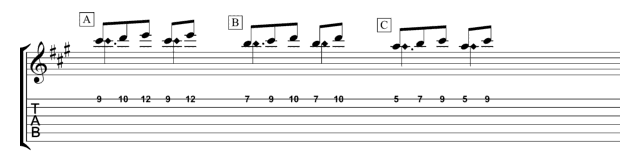
Remember these?descending major scale patternthree corresponding hand shapesWe first encountered these in ‘playing in position parts 7a’ and ‘7b’. It was in the latter article that I said that “the three patterns that we marked A, B and C (and the corresponding hand shapes) recur. There’s nothing particularly magical about this, it’s simply a side effect of how a major mode is constructed…”. Well, there isn’t anything magical about the patterns and shapes, but they do not come about purely by chance. As we cross the fingerboard, we’ll be encountering more and more of these recurring patterns, so to understand them, let’s have another look at the fingerboard hand.

Question: what is the distance between the first and fourth fingers?
Answer: three or four frets.

In other words, the fingerboard hand spans either a minor third (= 3 frets = 3 semitones) or a major third (= 4 frets = 4 semitones). Imprint this in your mind-body: the distance between the first and fourth finger is, in the case of the ‘finger-per-fret’ shape, a minor third or, in the case of the ‘extended’ shape, major third.
Keep this in mind, and many recurring patterns you’ll encounter on the fingerboard will make better sense. We’ll continue this in part 10b.

Tuesday, April 10, 2007

the art of persuasion

There I am, at the far end of the venue, listening to members of the class performing. It’s (more-or-less) a public performance, and the group is a little nervous—a little on edge. They’ve also been pushing themselves a little hard; everything’s a little longer, a little bit more complex. They’re sometimes loosing concentration; momentarily, but I can hear it, and I think they can too.
Inexplicably, four of the five performers drop out, leaving EC in solitude.
The quartet executed a textbook ending; except, well, it was a quintet on stage—one got left behind. You know how it goes: the texture—the density, the noise level, the information concentration—goes from 100% to 20% in a blink of an eye. If you’re left behind, you can feel vulnerable; if you’ve stopped, you feel like you’ve goofed up. (The key to this is that you cannot be left behind, nor can you have goofed up, but that’s a story of another post.)
I’m there willing EC to go on—go on—do a solo! I’m willing the rest (in rest) to resist the temptation to jump back in. Show some backbone. Come on, people, I think, I’ll give you As all ’round if you pull this off.
Unfortunately they don’t. The four join back in, and not even abruptly, but gently—tentatively. I’m left unconvinced (as I guess is the rest of the audience). It takes nerve; nerves that this group is a little too exhausted and nervous to call upon.
I realize, then, that so much of teaching improvisation is akin to teaching rhetoric—the art of persuasion.

Sunday, March 25, 2007

race: how many of us are just visiting?

I apologize for the lack of proper referencing, and the disjointed nature of this post. Most of these fragments were for separate articles, all in very rough form, but in light of Mwanji Ezana’s excellent articles on race and the jazz ‘avant-garde’ (‘don't say it too loud… part 1’ and ‘part 2’) and the blogospheric responses, it seems like a good opportunity to put it out there, ready or not….

“Let me ask you something… we Italians, we got our families, and we got the church; the Irish they have the homeland, jews their tradition; even the niggas, they got their music. What about you people, Mr. Wilson, what do you have?”
“The United States of America; the rest of you are just visiting.”
from Robert De Niro dir. (2006), The Good Shepherd.
I’m going to assume the following: discrimination and inequalities exist in these musics, and the (political and economic) systems in which these musics operate. Maybe in my most blinkered moments I hope that ‘we’ are different from other traditions (say, West European Concert Music), but I know that we’re embedded in a systemic problem.

A couple of anecdotes (both relatively recent):
  • A micro-festival: two non-white performers (neither black), one woman, out of a pool of maybe two dozen performers.
  • A small, single-day academic conference on experimental music: one woman speaker, no non-white faces.
Beyond this, however, is the the inability or reluctance to acknowledge, never mind tackle, this issue. Do we even want to take note of this? I wish I could say this was an exception….
I also know that propping up a mirror can be difficult and painful; that our first instincts may be to deny, deny, and then deny some more. It’s not our fault, we’ll say, and maybe later, well, we didn’t do this deliberately—with intent.
But none of that is going to get us anywhere.
Improvisative practices and traditions thrives on diversity, difference and, maybe, contradictions, but good intentions alone will not suffice. (I doubt Goodman, Wilson and Krupa came together by good intentions or by blind luck.)

exclusion from stories and contexts

‘Avant-garde’ does not mean one thing, but one of its meanings might be ‘transcending’ the mundane reality of historical, social, political specificity. Experimentalism (with or without the capital E) might mean flights of fancy ‘unrestrained’ by tradition and individual or collective identity.
Now, let me interpolate something here: those that are able to transcend historical specificity (class, race, gender, etc.) do so from a position of privilege.
I’m not saying that only white, upper/middle-class, heterosexual men can be avant-garde or experimental, but I am saying that it may be easier for those of us who fit that description to be seen as avant-garde or experimental. Maybe these terms have been defined with that in mind….
How often have we heard the lazy line that jazz follows in the footsteps of West European Concert Music. (Oh, we’ve laughed at that, but I digress….) What do you need to sweep under the carpet in order for that model of pre-ordained, inevitable, cultural evolution to work? Are musicians such as Fred Anderson or Bern Nix largely excluded from the (white sanctioned?) canon of avant-garders because their approach does not scan with experimentalist ideologies? Bern Nix’s approach to the instrument is as radical as anything I know, but, free from the screeches’n’scrawls and technological paraphernalia of officially sanctioned Radical Guitar™, is evidently not worthy of the canon. (Ishmael Wadada Leo Smith once critiqued the expression ‘extended technique’ as a way in which white, european avant-garde composers could appropriate the ‘novelty’ of techniques that have been well known—perhaps well documented, perhaps antique—in non-Western cultures.)

How does this match up on the avant-garde scale: John Zorn vs. Steve Coleman?
Or Reid vs. Frisell? So how come Vernon Reid, nominally (weren’t they all?) part of that Downtown scene, was so readily seen as a sell-out—just a rock musician who could have been—or a cross-over artist?

I remember, vaguely, in the middle of an angry, sometimes barely-veiled-racist, letters pages exchange regarding Public Enemy in Keyboard magazine in the early ’90s, one (black) writer asked when we would be able to talk about Duke Ellington as a great composer, and not a great jazz composer.

I’ve already done the Grove Taste Challenge, so I don’t need to repeat myself, but I recall George E. Lewis’ story about composer-performers Anthony Davis and Gerry Hemingway attampting to register as a composer with their publisher. Hemingway (in my mind the more performerly of the two) had no problems. Davis (closer of the two, perhaps, to the composer end of the spectrum) was prevented from doing so, and had to change publishers in order to achieve this.

beyond education that echoes colonialism

Questions of education and outreach tend to focus on, to put it bluntly, ‘bringing black folk back into the fold’. Well, beyond the patronizing, neo-colonialist streak, unless we accept major institutional revolutions we may still be in a situation of a token few black professors teaching white students, or that of white folk educating black folk about their own (African-American) self-worth. Do ‘we’ want ‘them’ to come to ‘us’, or are ‘we’ to go to ‘them’? ‘Outreach’ and ‘education’ can be the most misleading of words: who’s needs to educate who? Who needs to reach out to who?
We need a radical overhaul of how we talk and discuss education and outreach; what its ultimate societal aims are. Unless we do this, don’t see much success in a system that would ultimately keep ontological power—the power, in this case, to define the aims and objectives, the qualities and shape of, the avant-garde—in the hands of white hegemony.

Imagine a white guy barges into NAACP meeting and saying “don’t worry I will liberate you!” (Some people come very close to this.)

I have, however, a modest proposal to the overhaul of music education: let’s not call Charles Ives a Great (American) Composer, let’s make sure he’s identified as a white, male, middle-class, American composer. Let’s make sure that actors identified with positions of privilege cannot escape their markers. The New York School? White Men’s Club. Post-War European Avant-Garde? The same. Let’s stop pretending that we have a cultural (social and economic) meritocracy. Let’s see how much longer the system can bear up under such explicit hi-lighting of inequality.

follow the money

Race intersects with class in complex, but seemingly inexplicable, ways (if we’ve learned anything from the discussions surrounding Obama). This whole issue is tied up with funding, ticket prices, artists’ sustenance (to put it unglamorously), and access (including even less glamorous subjects such as public transportation and venue location). Does the music (and ‘unfettered’ experimentation) become a luxury for the middle-classes? The wealthy?

Try these for size:
  1. We want cultural participation by all (or the many).
  2. Economic factors stand in the way of this cultural participation.
If you disagree with A and B, you may as well stop reading now….
The bad ol’ days of the aristocratic patronage of the arts are over. However, the funding objectives have, in many respects, reverted to a pre-20th century model.
Let’s get a few things out of the way. In the context of music, the funding and subsidies that jazz and improvised musics receive is dwarfed what is received by institutions such as, say, national/regional orchestras and opera houses. Modern orchestras cannot exist without some form of subsidy. Indeed, I doubt ticket sales would sustain a big-budget, technicolor, bells’n’whistles staging of the Ring cycle (something that is done periodically). Yet, by and large, these are the venues and cultural forums for the white (and ‘almost-white’) middle-classes and, particularly in the U.S. and England, the rich. Music as it stands is becoming too much of a playground for the wealthy.
If we agree with points A and B, arts funding needs to be re-thought-out. As it currently stands, funding (including through taxation) is often used to subsidize the vanity projects and playthings of the haves and have-mores. (Hmm… am I sounding awfully socialist here?)

And what are the goals of the Lincoln Center—what are the dreams, desires and aspirations that the Lincoln Center (sees itself) embodying?

meanwhile, off the black-white axis

What does this mean for those of us who are not black, but not (quite) white either; those of us who have had the luxury of some choice in which ‘side’ to play for (in many cases, for unfortunate political expediency)? ‘White’ when convenient to do so, not-white, when otherwise. We can’t/won’t/shouldn’t sit on the fence, that’s for sure.
And what of those of us with (in some circumstances) perhaps less mobility than African Americans? e.g. Latinos in Southern California, Pakistani in England, Moroccans in The Netherlands?

and what about gender?

One final question: when is the equivalent debate on gender and jazz about to hit the blogosphere?