Showing posts with label identity. Show all posts

Saturday, July 25, 2015

broken families

“Did you know how loud you were?”
“Oh. Yes.”
“I thought you did.”

[Read the rest…]

Thursday, June 25, 2015

cosmic boredom

The most boring man in the world plays the most boring music in the world on the most boring instrument. He does this, why, he does not know, but he does this for that is what he does.

Saturday, November 08, 2014

when composers refuse to die young: or how to avoid making aging a liablity amongst the artistically inclined

More comedy from the arts sector (or is that the creative industries (I forget which)):

I’d heard that the Young Composers’ Collective (founded 2003) had changed their name to the Irish Composers' Collective (allegedly) because its members, who grew not-young, did not want to relinquish the organization. It turns out, however, there’s a little tradition of doing this: the Association of Young Irish Composers (founded 1972) dropped the ‘Young’ and became the AIC some ten years later.

Anyone tempted to do a Bourdieuian analysis of this phenomenon?

update 11-08-14:

I came across a piece from March 2004 re the Young Composers’ Collective. Full of moments of irony given the evolution of the AIC:

“I contacted a number of people to pitch the idea of starting a new organisation for young Irish composers…. Most of them agreed that more needed to be done for young composers in Ireland. I also contacted former members of the Association of Young Irish Composers which ceased activity in the 1970s. They all spoke positively of this organisation and lamented its demise….
“There is currently no support network for young Irish composers. The Association of Irish Composers (AIC) describes itself as Ireland’s representative body for composers…. It does little for young composers.”

Tuesday, October 14, 2014

Kind of Weird

Before people get too worked up over this, they need to realize that our album is a copy, not a clone—an object designed to reaffirm what people already love about ‘Kind of Blue’ and to highlight what we could and couldn’t pull off…. That’s where the art is—getting people to think about the original by listening harder to the differences. [more…]
Been following the MOPDTK/Blue threads here and there on fb with some interest. Some random questions:
  1. When does musical criticism cross into personal attacks? Is the personal and the musical ever separable, in particular, in the context of improvisative practices?
  2. At what point does musical proficiency sanction an entry into the hallowed domain of reinvention? (or is that question just wrong? what is at stake?)
  3. If the piece is a conceptual prank (of sorts), then is not the kerfuffle a demonstration of its success?
  4. If the piece is a conceptual prank, who or what was the target?
  5. When are we comfortable discussing the intersections of class, economics (and race) and music? (and if we can’t do this in the context of a kind of appropriation, when can we do it?)
I’ll admit straight off the bat that I’ve never been particularly drawn to MOPDTK’s work (no fault of theirs, just never got around to it), but this did at least get me to listen. fwiw, some thoughts (my ¢2):
  1. There’s a self-consistent argument from those critical of this project that goes like this: by all means do your own music—be creative!—but if you were to copy an existing work, your chops should be up to the task. I’m not 100% convinced by this argument, though it’s hard not to agree that there are people with more aptitude for meticulous recreations. I think notions of ‘authenticity’ and ‘respect’ (to/for yourself, the tradition, cultural ancestors, etc.) play in both pro/con arguments, but that are largely left unexamined.
  2. Given the continuing struggle with notions of history, continuity and tradition that is so much a part of this music’s DNA, it occurs to me that it would be naïve of anyone to think that the album would not generate, at the very least, heated discussions.
  3. It seems to me that that the target could not have realistically been the Lincoln Center neoclassicists and their audience since, given the nature of the band and the label, this piece of cultural noise would just not be audible there. So, it seems to be reasonable that the target of the prank was those of us already on the left-field (those of us already defending or critiquing this work), but that raises a whole bunch of additional questions about purpose, and questions about how to assess the success of the prank.
Final thought: I find it near impossible to hear Kind of Blue with something other than naïve teenage ears (which is how I first encountered that record). So I feel unqualified to do a critical, microscopic assessment of MOPDTK’s work-as-copy. From hearing a short excerpt from MOPDTK’s album, however, all I can add was that I was surprised how well Jon Irabagon could reembody Adderley, and fascinated how Peter Evans apparently could not mimic Davis to the same degree.

Friday, September 12, 2014

all that music journalism isn’t all that great

Music journalism is lazy.
Music journalism is vacuous.
Music journalism is soft headed.

Music journalism is dead, lost its way, and is no longer culturally or politically relevant. It has, to use present-day management parlance, no impact. Contemporary music journalists are shabby echos of their profession in times past; whose idea of research is YouTube; whose ‘intellectual engagement’ is based entirely on Wikipedia and some half-forgotten undergraduate reader; and who don’t even think to check out music outside their own little hipster enclave.
I would write more, but there’s only so much necrophilia I’d like to touch.

btw, if you need something else to read, try this brilliant and funny parody piece.

Monday, August 25, 2014

Eine kleine Nekromusik

When the Zombie Apocalypse is upon us, as the final ragtag few that is what is left of humanity gather to hear the last musician on the planet at the last piano with the last copy of Mozart’s piano sonatas, we will wait for the text to speak to us. As the undead hammer down the doors, the futility (always already) of fidelity to a long lost (fictional) past will become crushingly obvious.

Friday, December 28, 2012

unmasking tig

Although the most recent post is dated October 2012, improvising guitar hasn’t been active in any meaningful sense since January 2008. I started this blog in order to explore ideas of improvisation and technique, and as an outlet to vent issues emerging from my teaching [more…]. It was primarily for the latter reason that I adopted a pseudonym—the improvising guitarist, or tig. This was all in the relatively early days of weblogs, and, subsequently having written here and there under my non-pseudonymous name, I now feel more confident about expressing issues online without getting myself (or anyone else) into trouble.

As I said, I am “tempted to ‘come out of the closet’ on this blog,” so…


I still blog occasionally on (relatively) specialist matters, but, if you’re looking for my “unplanned collection of thoughts about the technical, social, pedagogical and practical dimensions of loosely idiomatic, sometime experimental, mostly open, always traditional improvisation”, your best bet, currently, is at a certain micro bogging platform.

Thanks for reading, everyone. Hope I can (again) make your acquaintance.

tig
Brooklyn, December 2012

P.S. a shout out to Kris Tiner, afaik, the only person who guessed the identity of tig.

Wednesday, October 24, 2012

practice based research: policing the borders of knowledge

Practice based research is not only a methodology, but is also tied to a metric, and, for you to be successful according to a metric, you need to play the game.
When I first encountered the term ‘practice based research,’ it promised to forge an academe that was more inclusive, border crossing. With creeping corporatism, however, practice based research instead became a way to solidify borders.
We all play the game. A (successful) practitioner outside academia knows to discriminate in their networking; to remember to, say, ask the Important Person at a concert about their family, to compliment the right people at a gallery, to have the right guest performer on their record, etc. And academia—with its bureaucratic pressures, need for peer esteem, to demonstrate ‘value’—is perhaps no different. As universities become knowledge/degree factories, as they are constantly asked to justify every penny, the metric, and the game, exists to reenforce the value of inside over that outside. This leads to some of problematic work and behavior written about elsewhere, and Bob Ostertag makes a similar point in regards Computer Music:

A phenomenon seen time and time again in academia: the more an area of knowledge becomes diffused in the public, the louder become the claims of those within the tower to exclusive expertise in the field, and the narrower become the criteria become for determining who the ‘experts’ actually are. [Read the rest…]
I’ve been to enough academic conferences/performances to encounter glazed eyes and interrupted conversations when someone discovers that I’m unaffiliated or semi-affiliated. No coincidence that this happens most often with junior academics as—with hostile job markets and promotion systems—they feel the greatest pressure to play the game.
I know academically affiliated researcher-practitioners who try their best to cross borders, but face an uphill struggle because the game rewards exclusivity. Academia should be a privileged space in which researchers, like arts practitioners outside academic borders, imagine and explore alternative modes of thought, interaction and sociality. However, for many unaffiliated practitioners who value what is offered by a conversation—an exchange of ideas and methodology—with academic practitioners, practice based research has not helped that conversation happen.

Tuesday, April 08, 2008

the grant application algorithm rev. 1.0.0

For FS.

A very simple algorithm:

1. Choose ‘edgy,’ trendy words and phrases that the arts organizations currently love (e.g. ‘collaborative’, ‘sustainability’, ‘interdisciplinary’, ‘defamiliarize’, ‘hybrids’).

2. Lay those words down as if on a scrabble table.

2.5. Optional: get intoxicated / stoned.

3. Try linking those words to make sentences (actual resemblance to grammar is purely coincidental).

4. Make sure targets and goals are not measurable (how exactly can you compute ‘artistic practice’?).

5. Voila! A completed grant application for the arts.

…Yeah, I was talking to a theater stage manager who hit the nail on the head: “arts funding is turning artists into liars.” Too true.

Sunday, February 10, 2008

well, this is depressing (addendum)

Dan asked for some background on the London Musicians’ Collective vs. Arts Council of England dispute. Most of what I know, I’d heard on the grapevine. While others have also blogged about it, possibly the most reliable info I have is from the LMC website itself. Look at the two articles ‘LMC Funding Crisis: January 2008’ and ‘LMC Funding Crisis: UPDATE 5 February 2008’. An except from the former article:

The LMC currently finds itself among nearly two hundred arts organisations who are having their Arts Council funding severely cut back. In December we received notice that Arts Council funding, which has always been fundamental to the LMC’s survival, will be cut off from 1 April 2008.
And the update:
Sadly the LMC has not been reprieved by the Arts Council of England, and our funding will stop from 31 March 2008.
We wrote to the Arts Council answering their points of criticism, but clearly failed to dent their intentions…. The fact is that events like the LMC Festival cost a lot of money, eg just one visa for a visiting musician runs into hundreds of pounds.
You may also want to have a look at some of the letters of support for the LMC.

BTW, apologies for not responding to all those who have left comments recently, I’ve been a little overwhelmed (if you can be a little overwhelmed) with stuff (including an upcoming performance with a former teacher of mine… time to practice).

Monday, January 21, 2008

the three ages of jazz pt. 1b: the nursery

Continued from pt. 1a…

the early bird (continued)

We’re joking about jumping up on stage and playing free jazz for this extremely hip ’bop club audience.

   …At least, I assume we’re joking.

Yet another conservatory band later, MH comes and shouts something into BC’s ear. It’s loud in the club so I don’t catch the conversation, but as MH struts towards the stage, BC, while opening the sax case, turns to me and says, “I think we’re on.”
I barely have time to parse what BC’s just told me. Before I can ask for confirmation, BC’s picked-up the soprano and headed for the stage.

   …Like I said, we’re running on pure adrenaline.

I fumble with my guitar, throw the case onto a crowded table, realize I don’t have a strap (I’ve been a sit-down player), hope there’s a chair I can use on stage, almost collide with TL and the bass, stare blankly at a wall of amplifiers that (apparently) every band has contributed to. I plug into one amp, can’t figure out the controls (goddamn high-tech, German engineering), try another… TL launches into the bassline for ‘Lonely Woman’, I stagger from the amp wall, hoping that the level ain’t too high or low, and realize I’m sans volume pedal. Oops.
We don’t stick with ‘Lonely Woman’ long; BC half-heartedly blows the first A of the head, but gives up for some post-Coltrane ‘free blowing’ (I realize later that I’ve never heard BC be so straight). I’m far, far, faaar too loud.
And I have no idea what I’m doing…

   …at all.

We’re done, the audience, to my surprise, cheer. BC turns ’round with the biggest smile you’ve seen in your life.

At Free Jazz Central, I kept asking TL if my volume level was too high, and now I’m apologizing again to the bass player for being waaaay too loud. TL says “not at all”, but I’m unconvinced, and BC laughs that I’m the only guitarist they know who worries about being too loud. I make a mental note: try and be a little less concerned about my volume level in the future. (I’ll be reminded of this many days later when some of my less capable students demonstrate a inflexible sense of volume. But that’s another story….)

Thursday, December 13, 2007

the three ages of jazz pt. 1a: the nursery

the early bird

Running on pure adrenaline from the gig (I don't realize this until it start wearing our a few days later), we march off to to hear one of MH’s pal’s performances.
We arrive at the venue. The contrast with Free Jazz Central is stark: the age of the Early Bird’s audience is, on balance, approximately half that of Free Jazz Central. They are younger, but otherwise more visibly diverse (in terms of race, gender, but possibly not in terms of class and education ). There’s also a lot more of them: it’s a noisy club where conversation competes with the band.

The band.

Well, it’s not often you can hear the Aebersolds quite so clearly. I haven’t encountered such copybook ’bop licks in a long, loooong time. Kinda refreshing, kinda stale; kinda cool, kinda sad… also oddly mind-numbing. BC and MH tell me that the Early Bird is the platform for the local music school students. Ah, I think, that explains it.
The conversation later turns to the fact that, when we were students (in formal education), we were never particularly good with changes.

I’ll confess it now: I was terrible in my attempts at ’bop.

Another confession: I get a real kick from hearing guitar players who can play those long ’bop lines. Really, I love ’em. Maybe it’s ’cause I sacrificed/neglected that facet of guitar playing for others. (I hear a little of those long lines in some non-’bop players such as Berne, of course, but that’s a pretty difficult trick… and a story for some other time.)

To be continued…

Tuesday, December 11, 2007

the three ages of jazz pt. 0: middle age

free jazz central

This gig was, well, not exactly hard work, but it definitely wasn’t effortless. Fun and educational, but it kept me on my toes.
Just before we start, I confessed to JS (the other guitarist) that it’s been about ten years since I shared the stage with another guitarist. Before the gig, I’d expected that impressing (or at least not pissing-off) the elders (one of whom a friend referred to, half-tongue-in-cheek, as a ‘giant’) in the ensemble would be my main concern, but by the end of the first set, I’m surprised as anyone that just about all I was worried about was staying out of the other guitarist’s way.
Actually, that’s pretty much sums up my tactic for the evening (and, I believe, JS’ as well).
Electric guitars are mid-range heavy. That’s fine in that ’bop setting in which the ride fills up the top end, fine in ’metal where the mid’s scooped out, but in this drummer-less improv setting, JS and I are in danger of creating an oppressive sound (especially as neither the horns nor the bass are going to add much above a few kHz).
After the gig, MH (who was there listening) tells me that all guitarists seem to have a love-hate relationship with their instrument. I respond that I love the physical/physiological relationship with the guitar—not every instrument rests against (hugs) your body while allowing for more-or-less full mobility of your arms—but the ‘sound’ (the raw audio content), well, that’s the problem; it just doesn’t always sit very well in an ensemble.
By the beginning of the second set, both JS and I feel like we’re running out of ideas. Between, Arto, Berne, Bill, Derek and Fred, say… or Annette and Keith… or Jimi, David and Sonny… isn’t that pretty much the scope of improvising guitar(ists)? What I mean by that is, as far as breeds of latter-day improvisers go, electric guitarist have a relatively small pool of models. At one point JS plays something, and I think, wait, I could do that too. I stop myself; it’s tempting, but I don’t think I would have been adding anything to the mix by aping JS doing a pseudo-Derek.

By the way, how’s this for the economics of free jazz: I sold a few CDs, but gave away just as many. Conclusion: it’s a good thing I’m not an accountant.

After the gig, a few of us journey on to witness jazz’s adolescent stage…

Saturday, December 08, 2007

this is not an obituary

Regarding the recently deceased Dead, White, German Dude, I’m not about to say

  1. he was a swell guy
  2. his music rocked
  3. he will be missed
because
  1. you gotta be joking me
  2. okay, maybe exactly two of his pieces really did (and, granted, a lot of the rest were fascinating failures), and
  3. hey, if there’s a post-War Avant-Garde Composer underrepresented and underdocumented, he ain’t it.
However…

…anyone who could compel the Arditti to make fools of themselves has more than a little going for them. Every time this Nut From The Dog Star managed to squeeze more funds from institutions ’round the world for his crazy plans, my respect for the man would skyrocket, but my view of those institutions would go down the drain.

Friday, December 07, 2007

the three ages of jazz: preamble

the jet-set improviser

As the plane approach the destination, I’m looking over The City at night. All those lights, I think. Beautiful as it is (the interconnection of metropolitan and suburban street patterns, for example), I wonder how much fuel we’re burning to get that effect. Then I wonder again what my carbon footprint from this journey is going to be.
I’ll be reminded of this sometime later when I hear CH’s description (and critique) of the latter day “jet-set improviser”; I am, after all, flying in to sit-in with a band.

Tuesday, October 09, 2007

clouds of garbage cans

I’ve heard that another teacher of improvisation finds that new students in their class play ‘chaotically,’ and that their lessons initially proceed by pulling back from that cacophony. It may be that this teacher (who, I think it’s fair to say, comes from a more composerly background) has different tastes / sensibilities / politics than I, but I have the opposite problem with new students: I seem to be spending a great deal of time pushing towards noise, encouraging the class to produce (to use that Braxtonian term again) “clouds of garbage cans”.
Maybe a better way to put it would be that I try and stop them from stopping themselves; I try to get them to exercise less a priori ‘tastefulness’. Many students come with a tendency to preempt the musical play (if that makes any sense). If a musician comes from a certain tradition (jazz, rock, country & western, circus music, whatever), I want to be able to hear that—I don’t want, nor feel the need for, their histories to be suppressed. And if the result is apparently cacophony, chaos or turbulence, well, I figure that’s at least an interesting place to be, and an interesting condition to interact with.
Citing Robert L. Douglas, George E. Lewis writes that

…Eurocentric music training… does not equip its students to hear music with multidominant rhythmic and melodic elements as anything but “noise,” “frenzy” or perhaps “chaos”.
George E. Lewis (2000), ‘Too Many Notes: Computers,
Complexity and Culture in Voyager’, Leonardo Music Journal (vol. 10), p. 34.
Recently, MLM commented on the similarity of approach—a heterogeneous sound world—in both the free jazz of The Shape of Jazz to Come (1959), and the Art Ensemble’s rendering (or appropriation) of Monteverdi’s ‘The Lament of Arianna’ on Les Stances A Sophie (1970). Listening to these, I can imagine a critic, intoxicated on the ideals of unity, coherence and integration, complain that the tuning of the voices are not aligned, the rhythms are not locked together; both Coleman’s group and the AEC are just not together.
Well, maybe, but beyond those losses—loss of unity, coherence and integration—what do we gain that may be of value? Both those (pre- and after-) harmolodics sound worlds are deliberately heterogeneous ones, or, maybe more accurately, practices in which difference, dissent and contradiction are not silenced (deliberately). Perhaps the (West European Concert Music) composerly approach leads to a kind of composition-as-censorship. In contrast, the AACM’s composer-performer approach, say, is one of of composition-as-facilitator, or the N.Y. Downtown’s composition-as-play.

Anyway, as a belated celebration of improvising guitar’s first anniversary, I’ll throw up that first quote:
What happens is what happens; is what you have created; is what you have to work with. What matters is to listen, to watch, to add to what is happening rather that subtract from it—and avoid the reflex of trying to make it into somthing you think it ought to be, rather than letting it become what it can be.
Anthony Frost and Ralph Yarrow (1990), Improvisation in Drama (London: MacMillan), pp. 2-3

an (unanswered) question

Is this analogous to the old debate in algorighmic composition which, to caricature it, revolves around two approaches to generative processes: start with some arbitrary noise, rich with possibilities, and systematically filter out the undesirable elements, vs. start with processes that ‘intelligently’ generate complexity?
The results, sound or reception wise, may be surprisingly similar, but the discourses embedded in these—the rhetoric that supports them—are maybe analogous to the debate I’m talking about.

And incidentally…

Isn’t The Shape of Jazz to Come a fantastic record title? What formidable ego could stand under that moniker? Is it tongue in cheek? Simultaneously humbling in front of the artform (yes, jazz is something worthy of a future), egomaniac (and this is its future) and pompous (Jazz-as-Art), it borders on the apocalyptic (who knows, maybe Darius Brubeck is right; maybe that was the moment jazz died ;-)

Thursday, September 13, 2007

thoughts from another concert

This one is a bit of a contrast to last time.

preconcert

Er… where is everyone?

Uh-oh. I hope this isn’t going to be one of those gigs that starts an hour late because the ‘star’ is not here yet.

Great. It is going to be one of those gigs that starts an hour late.

Correction: it’s going to be one of those gigs that starts an hour and a half late.

Audience demographics: about 50/50 male-to-female, fairly broad age range (again, not many below their twenties, however), predominantly white.

performance

What the hell? Is that the best you can do?
Maybe it’ll get better.

Points out of ten:
enthusiasm: 9
skill: 3
awareness of improvising traditions: 1…

…That last one might have to be downgraded to 0.5.

…Maybe zero.

That was lame.

This is lame.

I’m reminded of my college days when, punch drunk on (re)discovering ’6os/70s Miles, a bunch of us tried to recreate the vibe of In a Silent Way. That was, in retrospect, lame, lame, lame (not to mention silly, silly, silly). I had though, until now, that the only reasons you’d do this was because you’re young and stupid and/or high on psychotropics. This night’s lesson: apparently I was wrong on both counts.
…And, anyway, that vamp-on-one-chord really doesn’t work without the formidable ego—a Miles—at the center.

Don’t show-off. Please, don’t try and show-off. You’re not fooling anyone except yourself (at best).
I can be a big a fan of muscular, machismo virtuosity as the next person, but if you’re going to do a mindless physical workout, why do you have to handicap yourself with changes (and we’re not talking Coltrane changes here)?
…And, if you had Miles—the ego—there, there would be no point in showing-off (in fact, you’d probably get fired for showing-off).

And why is everything in four?

Thursday, September 06, 2007

warmup: comments and responses

Now that all that paperwork is done (at least for the moment), I can get back to this much neglected blog. (I haven’t posted anything here in about three weeks!) Thanks to those still reading this despite the sporadic posts.

…And thanks for all the comments (which I’ve also successfully, and with admirable consistency, failed to respond to).

In answer to my question about warming-up, David Ryshpan responds by listing some musical (“a major scale… that you go through different subdivisions of the beat”), borderline-musical (“first few exercises of Hanon”), and some extra-musical (“stretches I learned when I used to play tennis”) activities.
Another pianist Alex Hawkins picks up on the mention of Hanon, but finds that “the patterns [are] too ‘conventional’… they beguile… into complacency…”.

Incidentally, way back, when I did play the piano, my choice of warmup came from Brahms’ 51 Studies for Piano. Some combination of the position shifting exercise:

Brahms exercise no. 5.

and changing hand shape:

Brahms exercise no. 8.

There’s also the thumb pivot exercise, but this would be a riskier warmup since it could lead to injury if you over did it (it’s number 46, if you’re curious).
The position shifting exercise maps onto the guitar reasonably well. It corresponds to the one string melodies I’ve posted here—Jim Hall makes a similar suggestion in Exploring Jazz Guitar—or some upright bass intonation exercises that can be adapted to the guitar. There’s no real equivalent to the second exercise though (unless you subscribe to a Holdsworth-esque extended position). What’s interesting comparing the Hanon and the Brahms is that the Hanon is a little more mechanical—there’s an assumption that just physically following the tasks will lead to virtuosity—while the Brahms exercises won’t work unless you know what is being exercised.

…My teacher CL, however, swore by the Hanon. Go figure.

David’s reason for warming-up is

…not for any technical or musical reasons—it’s purely physical, to get the muscles primed, to avoid injury, and to get used to the instrument.
Seems reasonable, but does anyone disagree? A question might be, do the technical, musical and physical fall into neat discrete chunks? Let’s just say for the moment that they do not. If that’s the case, and warming-up is a combination of all three, what’s the difference between a warmup and a (public) performance? I mean, I’m assuming that none of us would warmup in front of an audience.
Well, as it happens, Alex finds that, “as a working musician”, he gets “from gigs all [he] would otherwise get from Hanon (i.e. a bit of a muscle workout).” This isn’t as strange as it maybe sounds, and I have on occasion integrated the warmup into the opening of my performances. (On the other hand, Peter Breslin, yet another pianist, notes the possible consequences of this no warmup approach.)

Pat, being a horn player, has a totally different take on the warmup process. There’s a part of me that envies wind players (and vocalists) in their approach to warming-up, but it’s an approach that doesn’t translate to a guitar or piano—we just don’t breathe in the same way.
That raises questions about the ‘character’ of instruments and the effect on the instrumentalist. Jeff (I assume this was Jeff Albert) remarks that
…extravagant and extrovert come out of a trombone much more naturally than subtle and introspective. That's does however open the issue of do we chose it because we are the way we are, or does it makes us the way we are….
Yes, it does raise that question, but maybe the answer lies in Jeff’s first sentence. What if I reworded it a little: the trombone rewards extravagant and extrovert playing. What I mean by that is that the electric guitar, for example, generally rewards (despite rock machismo theatrics) the delicate touch, maybe even “subtle and introspective”. There’s a kind of rule of diminishing rewards with electric guitars: playing with, say, broader gestures (e.g. picking harder) doesn’t necessarily translate sound-wise—something that guitar pedagogy sometimes neglects. As I’ve said before it’s often better to, turn up the amp, and pick lighter.
Which is not to say that instruments don’t come with culturally encoded expectations. Take, for example, the various possible identities encapsulated in the pianoforte. The instrument associated with Keithy-poo Jarrett’s tantrums, and consequently the debates about whether to read it cultural-semiotically as an enactment of class differences, or as a consequence of the ideology of genius.

It’s good to be back.

Wednesday, August 08, 2007

the audience vs. keithy-poo jarrett

Apparently there’s a little hoopla about Keith Jarrett’s crowd control skills. In response Daniel Biro writes an open letter to chastise Keith Jarrett (via DJA). Like another seemingly trivial story flagged up by On An Overgrown Path, there’s something fascinating going on here.

I’m not questioning whether people were bruised by the incident, but who exactly is upset? It seems that those taking ‘the audience’s side’ are put into a difficult position of simultaneously having to say that each audience member is individually responsible for their actions (“it is a gathering of individuals who are put together by chance…”) while speaking on behalf of ‘the audience’ as a corporate entity.
And why exactly are they upset? Is it, as some are phrasing this incident, a matter of offense, or is Jarrett’s behavior disturbing?
I have (a) complex relationship(s) with ‘my’ audience(s). Not difficult, necessarily, and certainly not unrewarding, but complex. I think we all do, and maybe those that don’t see complexity (or want to wish it away) are hiding behind unwritten rules that may prove fragile at best.

As an artist Jarrett is sublime, but as a person he leaves much to be desired. It was unfortunate that we had to witness the schizophrenia of these two aspects.
There’re discourses and there’re discourses: I’m not so much interested in whether The Keith Jarrett Incident was troubling because it was insulting (the truth of which will no doubt be debated elsewhere), but because it represents a kind of transgression—a boundary violation.
I reserve the right… and I think the privilege is yours to hear us, but I reserve the right….
Jarrett didn’t know his place as far as the audience (or those vocally audience-identified) was concerned. The flip side: the audience didn’t know its place as far as Jarrett was concerned.
MLM points out that the modern concert going culture in the West, emerging from the context of aristocracy, gets inherited by the bourgeoisie—the cultural elite and the economic focus. In this model, the audience embodies the ruling class; the performers, their servants. Is Jarrett’s behavior being perceived by those offended as a revolt by the servant class? As MLM asks: do the aristocrats fear their performing monkey becoming uppity?
When Biro states that “antagonism breeds antagonism” is there an underlying fear of a kind of class warfare mapped onto musical practice? That the ‘ideal’ state of things is that we should all be friends? That (materially expressed) love (“people pay lots of money… to see you play because they love you!”) should be reciprocated?
I see that red light there, and that means you, you, you….
Alarm bells go off when we hear this story: the many is found guilty of, and ‘punished’ for, the actions of a few. We know this injustice all too well in our post-9/11 political paranoia. We smell an abuse of power. We can map this easily: many = the well behaved majority in the audience; the few = the small number of pesky photo junkies.
But who or what does Jarrett stand for in this case? The “sadistic schoolmaster”? The colonial taskmaster? The White House? What exactly is resonating here?
…Tell all these assholes with cameras to turn them fucking off right now.
Once, MET, one of my teachers, was obliged to attend a meeting with wealthy patrons. I suggested that getting drunk, turning up with a half-finished bottle of whisky, and trying to start a fight would make the proceedings less painful, but MET pointed out that they would probably respond, “how wonderful: a real artist!”
We would never have expected ‘gentility’ from Miles Davis, of course. The Davis I witnessed, even mellowed in old age, performed someone from ‘the street’ (conveniently erasing his privileged upbringing), pumped full of a dangerous male, African-American sexuality. If Jarrett’s ethnicity and sexuality were, from a reception standpoint, less veiled and confused we would surely have an easier time.
The ‘unacceptable’ language in question: why should that be a shock? Is it because we all thought we were in the presence of a ‘classical’ musician—a musician with ‘class’—who’s suddenly revealed to be 50 Cent? This is, after all, a performer who famously recorded the Goldberg Variations, whose catalog is sprinkled with classy sounding titles such as The Köln Concert, and who appears on that classy label that boasts “quality… at all levels… [and] has been widely recognized and… has collected many awards”. A label which, nonetheless, is transparent (read: identity-free) and user-friendly (“All that can really be said about ‘ECM sound’… is that the sound that you hear is the sound that we like”).
Who do we expect our performers/artists/musicians to be? And why? And what happens when they don’t perform as expected?

btw…

The phrase in the title of this post (“Keithy-poo Jarrett”) is taken from Cecil Taylor (“…I don’t listen to Keithy-poo Jarrett, I’m not particularly interested in that”) quoted in Brian Priestley (1991), ‘florescent stripper’, Wire (issue 82/3, December/January), p. 24.

Friday, July 20, 2007

post-modern jazz guitar pt. 0b: 10 seconds of post-modernity


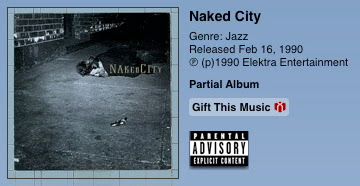
…But before I go I’ll let you in on the exact track I was talking about: ‘Snagglepuss’, track 7 of Naked City’s self-titled debut. What was my introduction to post-modern jazz guitar occurs at around 1' 40" of the track and lasts barely 10 seconds.Naked City at iTunes with explicit content warningIncidentally, the partial album (22 out of 26 tracks) is available on iTunes (with the complete album promised). Comically, this comes with an “explicit content warning” label which, I presume, is for the album artwork rather than for Yamatsuka Eye’s vocalese (but, hey, what do I know; I have no window into the workings of the RIAA). At ¢99, and clocking in at 2' 20", ‘Snagglepuss’ works out at just over ¢1.4 a second. That’s not much byte-for-your-buck, but much better than paying ¢9 a second for one of the 11 second tracks.