Showing posts with label guitar. Show all posts

Monday, October 20, 2014

The Jazz Police

“Spain’s Civil Guard (a.k.a. the Jazz Police) say Banksy’s real name is Lee Ritenour, a 62-year old male born in Los Angeles, California. AAJ has confirmed this information with Dave Grusin and Larry Rosen of GRP, along with Captain Fingers, a shady entity that acts as a cover for the so-called ‘octave jazz guitarist.’” [Read the rest…]

Monday, October 20, 2008

Methinied Morricone

I’m not averse to Morricone here at IG (I do, after all, suggest Cinema Paradiso as a melodic atom for practicing guitar…), but here’s something out of my normal orbit:

I would, however, never recommend Metheny’s technique as a starting point to any of my students.

Video via The Jazz Guitarist.

Monday, January 28, 2008

how dumb are guitarists

How dumb are guitarists (at least according to marketing)? Apparently very, very, very (perhaps up to 11+ on the dumb-o-meter).

“Re-issue”, “classic”, “special re-creation”, “original… formula”, “celebrates a return”, “vintage tones”. (Not bad for a 130 word press release).
But seriously, ladies and gentlemen: strings that are “hand-wound slowly”? “vibrate completely”? with “maximum sustain”? and “warm”?

Give me a break.

Tuesday, January 08, 2008

the vertical guitar(ist)

Well, in the guitar / guitarist / luthier sphere there’s that never ending quest to finally reengineer the posture. Considering how old the problem is, there’s surprisingly little in way of lateral thinking solutions.I’ll admit I’ve managed to be ignorant of Paul Galbraith until a few minutes ago, but he does seem to have an interesting solution.

Thursday, December 13, 2007

the three ages of jazz pt. 1a: the nursery

the early bird

Running on pure adrenaline from the gig (I don't realize this until it start wearing our a few days later), we march off to to hear one of MH’s pal’s performances.
We arrive at the venue. The contrast with Free Jazz Central is stark: the age of the Early Bird’s audience is, on balance, approximately half that of Free Jazz Central. They are younger, but otherwise more visibly diverse (in terms of race, gender, but possibly not in terms of class and education ). There’s also a lot more of them: it’s a noisy club where conversation competes with the band.

The band.

Well, it’s not often you can hear the Aebersolds quite so clearly. I haven’t encountered such copybook ’bop licks in a long, loooong time. Kinda refreshing, kinda stale; kinda cool, kinda sad… also oddly mind-numbing. BC and MH tell me that the Early Bird is the platform for the local music school students. Ah, I think, that explains it.
The conversation later turns to the fact that, when we were students (in formal education), we were never particularly good with changes.

I’ll confess it now: I was terrible in my attempts at ’bop.

Another confession: I get a real kick from hearing guitar players who can play those long ’bop lines. Really, I love ’em. Maybe it’s ’cause I sacrificed/neglected that facet of guitar playing for others. (I hear a little of those long lines in some non-’bop players such as Berne, of course, but that’s a pretty difficult trick… and a story for some other time.)

To be continued…

Tuesday, December 11, 2007

the three ages of jazz pt. 0: middle age

free jazz central

This gig was, well, not exactly hard work, but it definitely wasn’t effortless. Fun and educational, but it kept me on my toes.
Just before we start, I confessed to JS (the other guitarist) that it’s been about ten years since I shared the stage with another guitarist. Before the gig, I’d expected that impressing (or at least not pissing-off) the elders (one of whom a friend referred to, half-tongue-in-cheek, as a ‘giant’) in the ensemble would be my main concern, but by the end of the first set, I’m surprised as anyone that just about all I was worried about was staying out of the other guitarist’s way.
Actually, that’s pretty much sums up my tactic for the evening (and, I believe, JS’ as well).
Electric guitars are mid-range heavy. That’s fine in that ’bop setting in which the ride fills up the top end, fine in ’metal where the mid’s scooped out, but in this drummer-less improv setting, JS and I are in danger of creating an oppressive sound (especially as neither the horns nor the bass are going to add much above a few kHz).
After the gig, MH (who was there listening) tells me that all guitarists seem to have a love-hate relationship with their instrument. I respond that I love the physical/physiological relationship with the guitar—not every instrument rests against (hugs) your body while allowing for more-or-less full mobility of your arms—but the ‘sound’ (the raw audio content), well, that’s the problem; it just doesn’t always sit very well in an ensemble.
By the beginning of the second set, both JS and I feel like we’re running out of ideas. Between, Arto, Berne, Bill, Derek and Fred, say… or Annette and Keith… or Jimi, David and Sonny… isn’t that pretty much the scope of improvising guitar(ists)? What I mean by that is, as far as breeds of latter-day improvisers go, electric guitarist have a relatively small pool of models. At one point JS plays something, and I think, wait, I could do that too. I stop myself; it’s tempting, but I don’t think I would have been adding anything to the mix by aping JS doing a pseudo-Derek.

By the way, how’s this for the economics of free jazz: I sold a few CDs, but gave away just as many. Conclusion: it’s a good thing I’m not an accountant.

After the gig, a few of us journey on to witness jazz’s adolescent stage…

Thursday, September 06, 2007

warmup: comments and responses

Now that all that paperwork is done (at least for the moment), I can get back to this much neglected blog. (I haven’t posted anything here in about three weeks!) Thanks to those still reading this despite the sporadic posts.

…And thanks for all the comments (which I’ve also successfully, and with admirable consistency, failed to respond to).

In answer to my question about warming-up, David Ryshpan responds by listing some musical (“a major scale… that you go through different subdivisions of the beat”), borderline-musical (“first few exercises of Hanon”), and some extra-musical (“stretches I learned when I used to play tennis”) activities.
Another pianist Alex Hawkins picks up on the mention of Hanon, but finds that “the patterns [are] too ‘conventional’… they beguile… into complacency…”.

Incidentally, way back, when I did play the piano, my choice of warmup came from Brahms’ 51 Studies for Piano. Some combination of the position shifting exercise:

Brahms exercise no. 5.

and changing hand shape:

Brahms exercise no. 8.

There’s also the thumb pivot exercise, but this would be a riskier warmup since it could lead to injury if you over did it (it’s number 46, if you’re curious).
The position shifting exercise maps onto the guitar reasonably well. It corresponds to the one string melodies I’ve posted here—Jim Hall makes a similar suggestion in Exploring Jazz Guitar—or some upright bass intonation exercises that can be adapted to the guitar. There’s no real equivalent to the second exercise though (unless you subscribe to a Holdsworth-esque extended position). What’s interesting comparing the Hanon and the Brahms is that the Hanon is a little more mechanical—there’s an assumption that just physically following the tasks will lead to virtuosity—while the Brahms exercises won’t work unless you know what is being exercised.

…My teacher CL, however, swore by the Hanon. Go figure.

David’s reason for warming-up is

…not for any technical or musical reasons—it’s purely physical, to get the muscles primed, to avoid injury, and to get used to the instrument.
Seems reasonable, but does anyone disagree? A question might be, do the technical, musical and physical fall into neat discrete chunks? Let’s just say for the moment that they do not. If that’s the case, and warming-up is a combination of all three, what’s the difference between a warmup and a (public) performance? I mean, I’m assuming that none of us would warmup in front of an audience.
Well, as it happens, Alex finds that, “as a working musician”, he gets “from gigs all [he] would otherwise get from Hanon (i.e. a bit of a muscle workout).” This isn’t as strange as it maybe sounds, and I have on occasion integrated the warmup into the opening of my performances. (On the other hand, Peter Breslin, yet another pianist, notes the possible consequences of this no warmup approach.)

Pat, being a horn player, has a totally different take on the warmup process. There’s a part of me that envies wind players (and vocalists) in their approach to warming-up, but it’s an approach that doesn’t translate to a guitar or piano—we just don’t breathe in the same way.
That raises questions about the ‘character’ of instruments and the effect on the instrumentalist. Jeff (I assume this was Jeff Albert) remarks that
…extravagant and extrovert come out of a trombone much more naturally than subtle and introspective. That's does however open the issue of do we chose it because we are the way we are, or does it makes us the way we are….
Yes, it does raise that question, but maybe the answer lies in Jeff’s first sentence. What if I reworded it a little: the trombone rewards extravagant and extrovert playing. What I mean by that is that the electric guitar, for example, generally rewards (despite rock machismo theatrics) the delicate touch, maybe even “subtle and introspective”. There’s a kind of rule of diminishing rewards with electric guitars: playing with, say, broader gestures (e.g. picking harder) doesn’t necessarily translate sound-wise—something that guitar pedagogy sometimes neglects. As I’ve said before it’s often better to, turn up the amp, and pick lighter.
Which is not to say that instruments don’t come with culturally encoded expectations. Take, for example, the various possible identities encapsulated in the pianoforte. The instrument associated with Keithy-poo Jarrett’s tantrums, and consequently the debates about whether to read it cultural-semiotically as an enactment of class differences, or as a consequence of the ideology of genius.

It’s good to be back.

Friday, August 17, 2007

warmup: the rudiments

File this away with Airto’s tambourine solo, Bennink’s shoe solo, and maybe Prévost’s snare ‘piece’.

I’m not in the habit of writing obituaries here—many bloggers have done better elsewhere—so I won’t other than to add that one of the things I found fascinating about Roach was his complex relationship with pedagogy and technique.

What I do want to do is a little more modest: I want to talk about warming up. I don’t buy the idea that playing, say, scales across the guitar’s fingerboard counts for much of a warmup (those who disagree, please let me know). I’ve used various warmup routines over the years (some of which I plan to write about at some point), but none seem particularly well suited for the task for the improviser- guitarist. However, watching drummers warmup, going though simple rudiments (single strokes, double strokes, flams, etc.), I’ve begun thinking about possible transpositions of these techniques onto the guitar…. I’ll report back with more when I’ve explored this further.

In the meantime, a question: how do you warm up? and why?

Friday, July 20, 2007

post-modern jazz guitar pt. 0b: 10 seconds of post-modernity


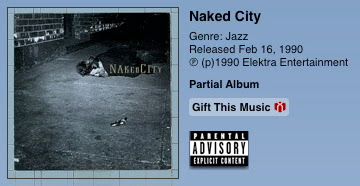
…But before I go I’ll let you in on the exact track I was talking about: ‘Snagglepuss’, track 7 of Naked City’s self-titled debut. What was my introduction to post-modern jazz guitar occurs at around 1' 40" of the track and lasts barely 10 seconds.Naked City at iTunes with explicit content warningIncidentally, the partial album (22 out of 26 tracks) is available on iTunes (with the complete album promised). Comically, this comes with an “explicit content warning” label which, I presume, is for the album artwork rather than for Yamatsuka Eye’s vocalese (but, hey, what do I know; I have no window into the workings of the RIAA). At ¢99, and clocking in at 2' 20", ‘Snagglepuss’ works out at just over ¢1.4 a second. That’s not much byte-for-your-buck, but much better than paying ¢9 a second for one of the 11 second tracks.

Monday, July 16, 2007

post-modern jazz guitar pt. 0: electric authenticity

Continued as promised…

When asked, in an article in The Guardian, if she gets frustrated by other singers’ approach to standards, Mina Agossi answers:

…Some people sing standards in the way that the greats did, with such conviction, love and authenticity that, really, it touches me. But if you ask me whether I learn something from that, or if it is something that opens a door, I would say no. It's beautiful, it's nice, but it doesn't touch me.
What happens when Agossi evokes, say, Billie Holiday (or any number of others) in her performance? What happens when I hear something of Holiday in Agossi—a singer/vocalist with much greater range than Holiday ever had? Not directly quoting Holiday, not mimicking Holiday (well, not exactly), and certainly not pretending to be Holiday. Nevertheless, what’s happening, and why is it electric?

visionsong impossibly (and fantastically) managed to get ‘postmodern’ and ‘authenticity’ to sit next to each other:
If there is such a thing as postmodern authenticity, then he's [Bill Frisell’s] it. He was embracing an eclectic mish-mash of Hendrix, folk Americana, thrash and bleep and blurp long before most of them were in vogue, and the times seem to have caught up with him, in a good way.
I recall the first time I became aware of ‘post-modern jazz guitar’ (or maybe that should be ‘‘post-modern’ ‘‘jazz’ guitar’’ or something) even though I wouldn’t have been able to call it as such at the time.
Bill Frisell’s sound I knew from some sporadic, and sometimes eccentric, appearances as sideman, most notably (to my ears at the time), as the quirky, independent-minded ‘other’ guitarist in Bass Desires (hey, anyone remember ‘Twister’?), but it’s his appearance on the self-titled Naked City debut recording (1989, Nonesuch) that marks my introduction to post-modern jazz guitar.

On some mundane, obvious level, Naked City was scatter-brained. Certainly critics at the time of its release, possibly because of a concern for material rather than practice, had difficulty hearing anything other than post-modern collage. On the other hand, in retrospect, it’s perhaps surprising that so little of the band had an overtly post-modern agenda: Fred Frith would return to that hybrid rock experimentalism; Joey Baron had no difficulty retaining his all-purpose bounce; Wayne Horvitz continued to walk the tight-rope act of downtown traditionalist; maybe even John Zorn’s taste for bricolage and sampling had more to do with the collision of Experimentalisms, African-American ‘noise’, and hardcore.

And then there’s Frisell.

Frisell’s interest in Americana, and, latterly, in cross-cultural (mis)understandings, displayed a concern for history that went beyond the temporal agnosticism of post-modernism.

Or did it?

Frisell’s deployment of those ’bop licks acknowledges history—of precedence—but it is not about authenticity, nor does it purport to be authentic. It ain’t authentic in either the sense colloquially used in the domain of historically informed performance (of which jazz neo-classicism might be a special branch), nor in the sense of an embodied authenticity as Simon Frith-ites might discuss in the context of popular music. This enrollment of jazz guitar history and practice is a strage and fascinating, perfectly crafted piece of… of what?
I’m not sure what I’m hearing when I spin that track (I’ll let you in on the exact track in the next part of this thread). Am I hearing a condensation of history (a collapsing of time), or a meaningless token (albeit free from the pretentions that dogs neo-classicism)? Is it a form of due-paying, or is it mocking the jazz traditions’ emphasis on cultural lineage? Or something else? or something in between? or a rapid-fire oscillation between states? I don’t know what I’m hearing, but the effects are dramatic (in that microcosmic moment) and electric.

To be continued…

an (unanswered) question

Does Frisell cultivate that shy, gawky, slightly goofy mid-western persona?
MLM and I used to joke that Frisell would meticulously practice his awkward delivery in preparation for introducing his band/pieces. Are questions of authenticity relevant to Frisell’s persona? Is it an act? Is persona (or identity) performance?

…and two questions from last time

What is, or what is constructed by the label, post-modern jazz?
Is, or do you find, post-modern jazz to be a positive development?

Friday, July 06, 2007

post-modern jazz guitar (preamble)

I’m out of town (always a little strange to be traveling without being weighed down by a guitar and amp) so I’ll be offblog for a few days. When I return, I plan to write on the subject of ‘post-modern jazz (guitar)’, so…

a couple of questions for y’all

What is, or what is constructed by the label, post-modern jazz?
It’s not at all a straightforward thing to use the ‘post-modern’ moniker in place of other labels (‘classicism’, ‘expressionism’, ‘orientalism’, etc.). The (informal? tenuous? hostile?) relationship between (cultural) modernism and (social) modernity finds no correlating expression between post-modernism and post-modernity. How can the post-modern stand for an aesthetic or sensibility? it is, after all, a condition, not a era or a milieu.
Of course, none of that stops us from trying.

Is, or do you find, post-modern jazz to be a positive development?
I’m curious about your reaction to post-modern jazz (whatever that is, and if such a thing exists): positive, negative, indifferent?

Thursday, June 28, 2007

thumb as fulcrum

Well, I have to admit this is a pretty good introduction to string bending from (and I can’t quite believe I’m citing this) Berkleemusic.

Only (very minor) point I would make is that it isn’t really your wrist that’s doing the bending, but your arm while using the thumb over the neck as a fulcrum.
(Via A Guitar Teacher’s Lesson Notebook.)

Thursday, June 07, 2007

practicing: systems, routines and shake-ups

Taylor Ho Bynum can practice while watching television. HTP, a bass player, used to practice by playing along to every spot during a commercial break (which has a kind of scatter-brained, post-modern logic to it). I’m impressed (and a little dizzy with the idea), but, really, I couldn’t do that. I need both sets of ears and eyes: I’m afraid that I’ll miss something and screw-up if I let my attention drift.

Okay, as I’ve said before, I’m a systems junkie.

My routine (which goes through the occasional, irregular shake-up) right now consists of ‘natural’ harmonics; scalar patters that alternate open and stopped strings; clusters and ‘pseudo-clusters’; and ‘touch’ playing. (Did you noticed that this resembles humble lexicon?) Thrown into that mix are articulations via the volume pedal. (I also live by the metronome, but that’s another story….)
’Cause there’s not enough hours in the day, and you can only do so much practicing without hitting a physical / physiological / mental / spiritual wall, my practicing ‘regime’ (maybe ‘ritual’ is a better word) has, at the moment, a four day cycle. This also means I don’t practice the same thing more than once every four days. I do, however, try and cover all the bases each day, so I’ll have four sets of harmonics exercises, four sets of cluster based patterns, etc. to cycle through.
Now that all looks frozen and durable, but of course it ain’t. These elements are “exercises to followup on technically curious… gestures and structurings. …These exercises evolve not through some grand plan, but by adding kinks and extra complications.” In his own post about practicing, Dominic Lash makes a similar point:

A given practice regimen for me tends to last a few months before I rearrange things but the broad categories remain the same…. But the regime has to feel fresh for me to feel excited enough actually to pick the bass up, and the best way to do this is change things about periodically.
And recently (and whenever it happens, it comes as a surprise) I’ve found myself at the early stages of going through one of those shake-ups. I’m equal measures excited and anxious about this….

Tuesday, May 22, 2007

thoughts from a jazz recital

Still crazy here at TIG & MLM central, so the blog posts will be erratic at best for the time being…. Anyway, I was listening in on a student recital in the jazz division (not my class you understand—I was just an audience member), and a few things caught my ear.

complex heads, simple heads

I admired the group’s courage in tacking some pretty tricky material (a Joshua Redman piece which I wasn’t familiar with). A bit of a gamble by the performers since the head was pretty intricate, and, as I suspected, their solos didn’t quite live up to that level of complexity. It did get me wondering about some of the harmonically elaborate compositions of Coltrane and (earlier) Shorter, say, and how the melodies of those were often quite simple.
Take ‘Giant Steps’ or ‘Countdown’: were the simple ‘melodies’ (which, given their simplicity, almost seems like the wrong word for it) engineered to subdue expectations about the solo? Given the difficulty and, as Evan Parker calls it, ‘problem solving’ nature of the changes, did Coltrane create low-key melodies so that the solo would be a shock of energy? Did he fear that writing complex melodies would make the soloist’s job, given the experimental nature of the changes, untenable?

(Later, most notably in jazz-rock and fusion, you’d start getting intricate ‘melodies’ (and considering their complexity, that also seems like the wrong word for it) over similar changes, but with the promise of solos that were of an even greater bravado of virtuosity, but that’s another story….)

(Another solution might be, admittedly from a rock sensibility, Zappa’s in which the solo only tangentially had anything to do with the ‘head’. The rhythmic and harmonic riot of ‘Approximate’ followed by a riotous guitar solo over a relatively straightforward r’n’b groove, for example. That’s, however, definitely another story….)

jazz: year zero

Listening to the bass player walking in a pre-Carter, pre-Holland manner, the question that came to my mind was why does so much of jazz pedagogy take its year zero as 1945 (±10 years)?
Okay, we all learned jazz guitar from, say, Freddie Green onwards, but does that make sense in terms of careers—in terms of developing an individual sound—in this latter-day jazz context? We could take the model of Tal Farlow as the starting point, or Wes Montgomery. But there’s also a certain logic to taking, perhaps, John Abercrombie as a starting point. As far as I can hear (and I know I’m on very slippery ground saying this), we are living in an after-Abercrombie jazz guitar environment.

(Hey, I might be tempted to start with Nix or Sharrock, but that probably disqualifies me as a jazz guitarist ;-)

There’s an argument that goes, well, the earlier traditions—their methodologies, their practices—shaped what followed, and to understand the latter entails first learning the former (e.g. Abercrombie’s sound was informed by his models). Well, fine, however, although we could arbitrarily turn the pedagogical clock as far back as the historical record enables, we don’t do that in practice for pragmatic reasons: life, at school and after, is too short. Neither Charlie Christian nor Django Reinhardt feature much in orthodox teaching literature, for example, for, I imagine, this reason. (Tangentially, I’m not sure that learning to ape Palestrina, as interesting in itself as it may be, is going to help a budding West European composer find their place in an after-Lachenmann sensibility.) We all learn by choosing some arbitrary (historical) starting point, and shift and skip (forwards/backwards) as the learning experience takes us.
Additionally, we (mainstream jazz audiences) don’t generally expect young(er) jazz musicians to sound like old-timers. We expect them to come from an after-Shorter, after-Jarrett, after-Carter, after-DeJohnette common practice. Very few young(er) jazz musicians are asked to perform in the ‘older-style’ unless as some kind of post-modern pantomime act, or as a house band for visiting elder luminaries (and, as that generation departs to that great club in the sky, I’ve heard less and less of these over the years). Certainly very, very, very few of the jazz musicians I know play ’bop anymore (but maybe I just have weird friends).

Even the neo-classicists take (and now I’m on extremely slippery ground) The Jazz Messengers (c. 1960) as their year zero.

Furthermore, a vibrant local scene gains international recognition, not through its ability to pastiche, but through its display of some distinct take on this common practice (e.g. the recent rise in visibility of many Scandinavian jazz musicians).
So why is so much of formal jazz education still stuck in the Aebersold time-line?

(BTW, I’m talking about ‘mainstream’ jazz here, sidestepping the question of how, as Bailey asks, Ayler’s music could be distilled into a ‘method’. Also, I’ve only witnessed formal jazz education at three institutions (admittedly in three different countries), so this might not be representative.)

it’s electric, dummy!

The notion that an electric guitar is just an amplified version of an acoustic has done no good whatsoever to the teaching of that instrument. Come on, man, turn up the amp, and pick lighter!

Friday, May 11, 2007

great moments in elvis history

Mythologies abound in all traditions. It may be the thing that defines a tradition. Big Computer Music has narratives of ‘the future’ (to which, technoculturally assisted, we inevitably(?) escape); it’s hard for me to imagine an Early Music which doesn’t enroll ‘historical informants’ (whether present-day constructions or not); and latter-day improvised musics have stories about ‘freedom’ (stuck in a contradictory oscillation between individualism and collectivism)….

Hmm….

Let me bring in a visual aid:

Intertextuality has, or anachronisms have, rarely been so much fun (or stupid (or funny)).

Bonus question: Is the Elvis portrayed above, an imperialist?

Sunday, April 29, 2007

bailey & lewis

No particular reason to post this other than it’s a pleasure to see two of my models (would it be presumptuous to say elders?)—one in regards to the instrument, the other in regards to tactics and strategies—captured together on video…

…although I can think of few improvisers who differ so much ideologically and politically.

Sunday, April 15, 2007

playing in position pt. 10a: spanning a third

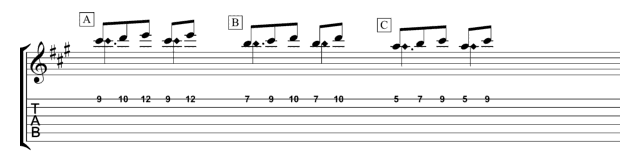
Remember these?descending major scale patternthree corresponding hand shapesWe first encountered these in ‘playing in position parts 7a’ and ‘7b’. It was in the latter article that I said that “the three patterns that we marked A, B and C (and the corresponding hand shapes) recur. There’s nothing particularly magical about this, it’s simply a side effect of how a major mode is constructed…”. Well, there isn’t anything magical about the patterns and shapes, but they do not come about purely by chance. As we cross the fingerboard, we’ll be encountering more and more of these recurring patterns, so to understand them, let’s have another look at the fingerboard hand.

Question: what is the distance between the first and fourth fingers?
Answer: three or four frets.

In other words, the fingerboard hand spans either a minor third (= 3 frets = 3 semitones) or a major third (= 4 frets = 4 semitones). Imprint this in your mind-body: the distance between the first and fourth finger is, in the case of the ‘finger-per-fret’ shape, a minor third or, in the case of the ‘extended’ shape, major third.
Keep this in mind, and many recurring patterns you’ll encounter on the fingerboard will make better sense. We’ll continue this in part 10b.

Wednesday, April 04, 2007

solo: primary territories

Given that my lexicon is so pared down, what do I do—what can I do—with, or within, it? I could atomize theses elements further, but I prefer to see these as regions in which I have a certain amount of mobility. Here again is where the language metaphor breaks down: to borrow (admittedly out of context) a term from Anthony Braxton, these three elements—harmonics, clusters, and ‘touch’ playing—are primary territories.
I can get a certain amount of movement within each territory. Natural harmonics can be, for example, melodic or rhythmic, concerned with intervalic color or timbre.

listen

Clusters and ‘displaced’ clusters (pseudo-clusters which I’ll explore in more detail in future posts) can be approached, say, pianistically (à la Tippett), or more guitaristically (à la Frith).

listen

Circular-breathing wind players (e.g. Parker, Mitchell) get incredible creative milage from constructing illusions of polyphony and lines that are impossibly long. And while, I admit, it’s strange to bring these tactics to bear on a polyphonic instrument that doesn’t need to breathe, two-hand ‘touch’ playing nonetheless gets me within, maybe, commuting distance of this neighborhood.
In addition, since, without radical techniques that are alien to me, I’ll never be able to deploy clusters to approach the complexity, density or noise-level (I’m not talking about loudness, you understand) of pianists like Taylor or Crispell, a variant of ‘touch’ playing is maybe as close as I can get.

listen

But none of this gets me very far, certainly on stage. Time to perhaps renegotiate boundaries….

[BTW, the audio recordings were made quickly, so apologies for the quality (or lack there of).]

updates:

04-05-07: Use the XSPF Flash Player. Please let me know of any problems.

Friday, March 30, 2007

listening: feeling the string tension

Towards the end of Chan-Wook Park’s Lady Vengeance (Chinjeolhan Geum-Jassi) there’s a forty second close-up of the main character.image from Lady VengeanceIt’s an extraordinary scene in which you see the face of the main character (played by Yeong-ae Lee) crumple and contort, hovering uneasily between expressions of despair (mourning, perhaps?), relief, triumph, and half a dozen undefinable, unspecifiable states. It’s extraordinary also because, as you watch the scene progress, you can almost feel her muscles working under her face. It’s as if your face (not your eyes, not your brain) is responding to the scene; telling you what is happening, what to feel, how to empathize.

Listening to the radio last night and MLM asked if I could identify the type of guitar by ear. Well, beyond the obvious, all I can identify is a cloud of possibilities—probable combinations—that might be deployed to get a certain sound. The obvious: acoustic/electric, nylon/steel strings, finger/plectrum, etc. The probable: how its mic’d-up, pickups used, recording technologies, etc.
What surprised me, however, was that I could hear the string tension. Actually, scratch that, I could feel the string tension. On the guitar of a track on the radio, for example, I could feel that the strings were of higher tension than what I’m used to: an acoustic guitar with probably a higher action, maybe heavier strings. Later, listening to a recording by Bill Frisell, I could tell that he has much lower string tension, on the electric, than I do (even though Frisell tends to tune slightly sharp of Concert): Frisell probably uses lighter strings.
The funny thing is, it really is (almost) a bodily reaction—feeling the string tension—it does register in my fingers, arm, etc. (MLM, being a vocalist, has analogous reactions to recorded voices.) And, like watching that shot in Lady Vengeance, I know—I think I know—that it must be my sensory and cognitive mechanisms (ears-nerves-brain), that is constructing this model, but the (empathetic?) effects seem to be in my sinews and my muscles.

Does anyone else have similar responses? And does it seem to register in your body?

Tuesday, March 06, 2007

playing in position pt. 9: fingerboard geometry

To simplify things, there’s basically three ways to change the pitch on a chordophone like a guitar: change the tension of the string, change the mass of the string, or change the effective vibrating length of the string. On the guitar the tension of the string is altered by ‘bending’ the strings or via mechanical means (e.g. tuning machines, a mechanical ‘detuner’ or whammy bar). In the context of position playing, however, it’s the latter two (mass and length of the vibrating string) that we’re interested in.The fingerboard as cartesian spaceYou can view the fingerboard as a two dimensional space in which pitch is dependent on the position both longitudinally and transversally in relation to the strings. Pitch is altered by moving up and down the string (changing the vibrating length of the string) or by moving perpendicular to the string, across the fingerboard (selecting strings of different mass and, to some extent, tension).
In our exploration of playing in position, thus far, we’ve really only concentrated on the first of these dimensions, but we’re about to extend playing in position across the fingerboard. (Or, recalling my earlier metaphor of the guitar fingerboard as “a set of single-pole, multi-throw switches”, having concentrated our efforts on the individual switches, we are about to practice moving between the switches.)

One of the interesting side effects this 2-dimesional arrangement is that the same pitch may appear at multiple coordinates on the fingerboard:E4 at six positions on the fingerboardAnother is that shapes derived from the comfortable hand shape (the diagonal fretting pattern that, from first to fourth finger, moves bass to treble across the strings, and bass to treble up the frets) tend to maximize the pitch interval available, while the reversed diagonal shape tends to minimize them. (These factors will become significant in, for example, the playing of clusters.)diagonal and reverse diagonal shapesKeep these ideas in mind as you approach the 2-dimensional fingerboard: you’re about to take a step towards what some players describe as the fingerboard ‘lighting up’….